FT·SYM·061Architecture & Landscape
Mani Stones
མ་ཎི་རྡོ
Wyliema ṇi rdo
Stones carved with the six-syllable mantra or other sacred texts and images, placed singly or heaped into long walls along paths and at holy places.
Also known asMani Stone · Mani Wall · Mendong · Mani Do · Mani Dobum
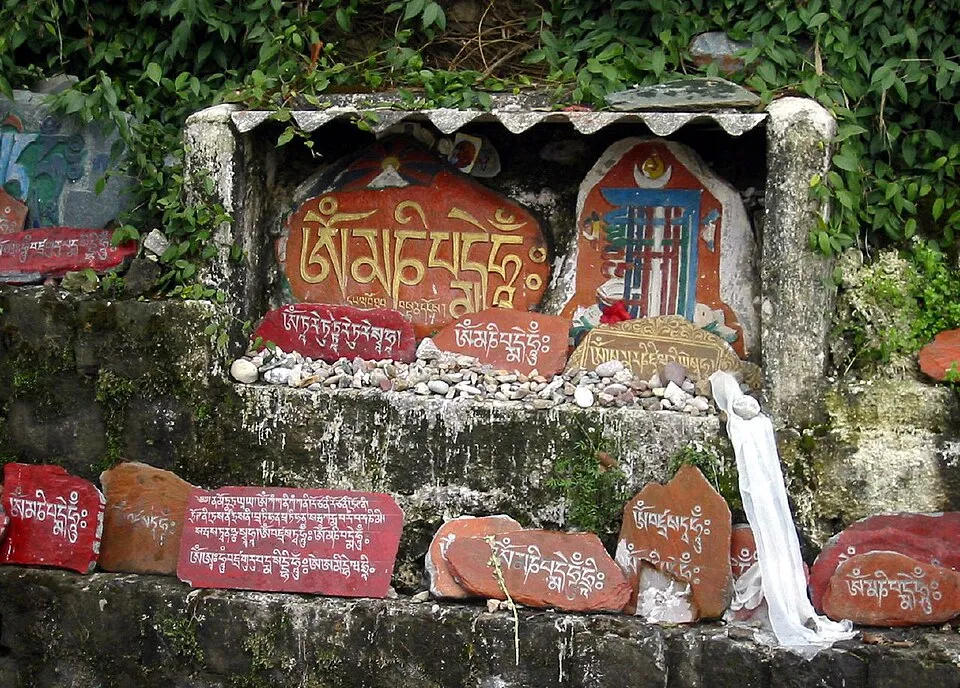
A mani stone is a rock or slab carved with a prayer, most often the mantra om mani padme hum, from which it takes its name. Commissioning or carving one is an act of merit dedicated to a person’s welfare, to the dead or to all beings, and leaving it in a public place lets every passer-by share the benefit. Over generations single stones accumulate into cairns and into walls that may run for hundreds of metres. They are a defining feature of the landscape across Tibet, Ladakh, Nepal, Bhutan and Mongolia.
Stones range from river pebbles to dressed slates more than a metre across. The usual technique cuts away the background so that the letters stand in low relief at the original surface, and simpler stones are incised. Texts are written in Tibetan script or in ornamental Lantsa, and the syllables may be painted in their six colours, white, green, yellow, blue, red and dark blue. Other stones bear longer prayers, whole sutras spread over many slabs, or figures of buddhas, bodhisattvas and teachers. A mani wall is a long low platform of rubble faced and topped with such stones, sometimes with a stupa at each end.
Buddhists pass a mani wall keeping it on their right, so that they move around it clockwise, and paths often divide to allow this in both directions. Stone carvers work beside pilgrimage routes and take commissions from travellers. The Gyanak Mani at Jyekundo in eastern Tibet, begun according to local tradition in the eighteenth century, is commonly described as the largest accumulation of mani stones in the world. Bön followers carve their own mantra in the same manner. Removing stones from a wall is considered a serious fault.
Connections
12 linked records across the archive.
Sources
References consulted for this record.
- 01Mani stone — Wikipedia
- 02Om mani padme hum — Wikipedia
- 03Robert Beer, The Encyclopedia of Tibetan Symbols and Motifs (Shambhala, 1999)