FT·PLA·042Monastery
Yonghe Temple
དགའ་ལྡན་བྱིན་ཆགས་གླིང
Wyliedga' ldan byin chags glingDatebuilt 1694; monastery from 1744
Former princely palace in Beijing converted in 1744 into a Gelug monastery, the chief centre of Tibetan Buddhism at the Qing court and still an active temple.
Also known asYonghegong · Lama Temple · Yonghe Lamasery · Ganden Jinchak Ling · Palace of Harmony and Peace
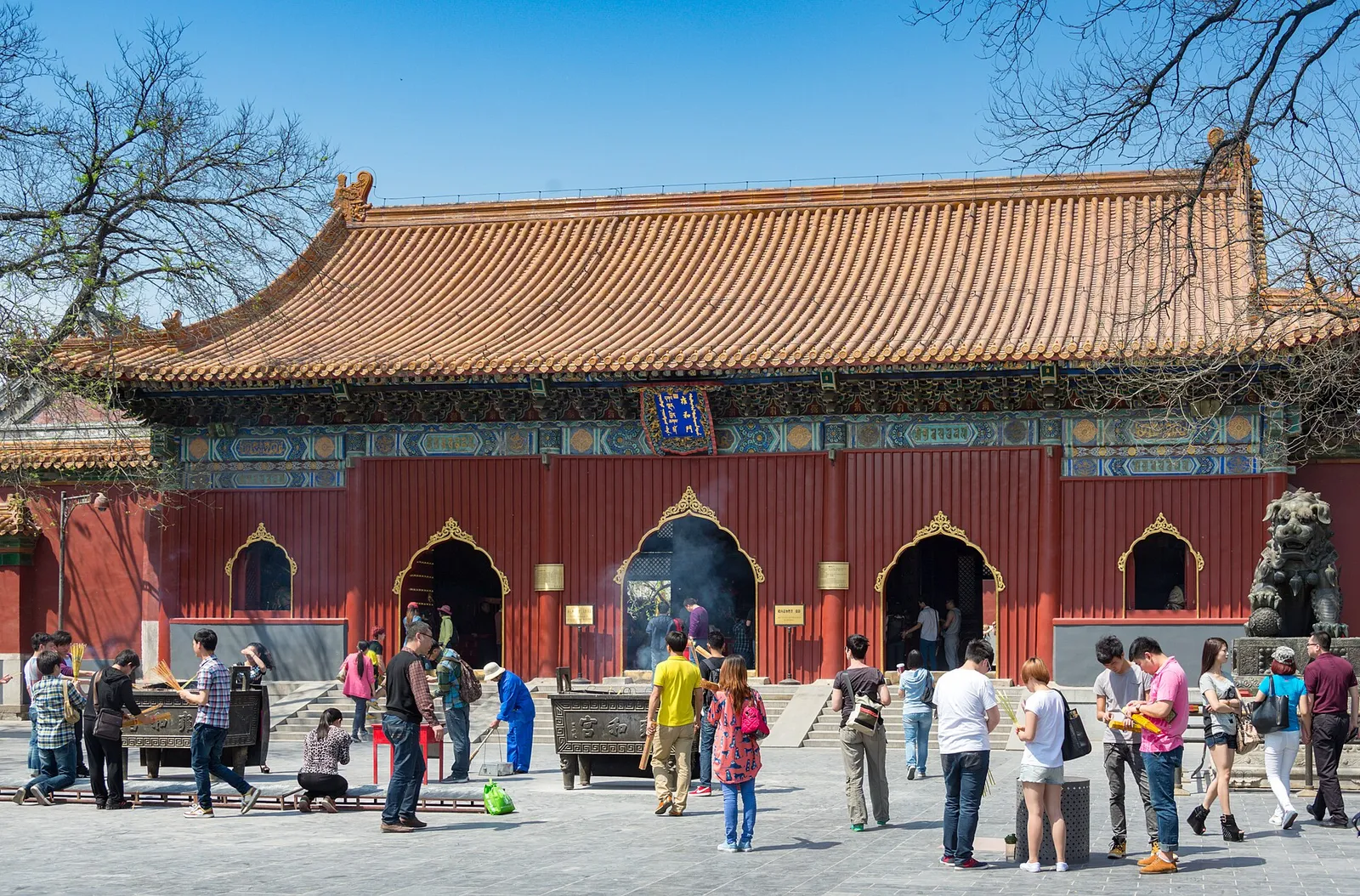
Yonghegong, the ‘Palace of Harmony and Peace’, was built in 1694 as the residence of Prince Yong, who reigned from 1722 as the Yongzheng Emperor. In 1744 his son the Qianlong Emperor turned it into a monastery of the Gelug school, with the Tibetan name Ganden Jinchak Ling. It housed several hundred Mongol, Manchu and Tibetan monks in colleges of philosophy, tantra, medicine and astronomy, and served the Qing dynasty as its main institution for managing relations with the Buddhists of Mongolia and Tibet. Its senior teachers were leading lamas brought from Tibet and Amdo.
The complex lies in the north-east of old Beijing and extends some 480 metres from south to north through a series of courtyards and five principal halls, built in Chinese palace style with yellow-glazed roofs and inscriptions in Manchu, Chinese, Mongolian and Tibetan. The halls contain images of the Buddhas of the three times, a large bronze Tsongkhapa, and fine Sino-Tibetan thangkas and ritual objects. The last and tallest hall, the Wanfu Pavilion, holds a standing Maitreya eighteen metres high above ground, carved from a single sandalwood trunk that the Seventh Dalai Lama sent to the emperor.
From the 1790s one of two golden urns used under Qing regulations for drawing lots to confirm high reincarnate lamas was kept here, for use with Mongol candidates; the other was sent to the Jokhang in Lhasa. The monastery declined after the fall of the dynasty in 1911 and was closed during the Cultural Revolution, though its buildings were spared, reportedly through the intervention of Premier Zhou Enlai. It reopened in 1981. Today it has a resident community of monks, many of them Mongol, and is among the most visited religious sites in Beijing, crowded with worshippers offering incense at the new year.
Connections
8 linked records across the archive.
Sources
References consulted for this record.
- 01Yonghe Temple — Wikipedia
- 02Patricia Berger, Empire of Emptiness: Buddhist Art and Political Authority in Qing China (University of Hawai'i Press, 2003)
- 03Ferdinand D. Lessing, Yung-ho-kung: An Iconography of the Lamaist Cathedral in Peking (Sino-Swedish Expedition, 1942)