FT·PLA·048Sacred Mountain
Wutai Shan
རི་བོ་རྩེ་ལྔ
Wylieri bo rtse lngaDateBuddhist site from c. 5th century
Cluster of five flat-topped peaks in Shanxi, China, revered as the earthly abode of the bodhisattva Manjushri and visited by Tibetan and Mongol pilgrims for centuries.
Also known asMount Wutai · Riwo Tsenga · Five-Peaked Mountain · Wutaishan · Qingliang Shan
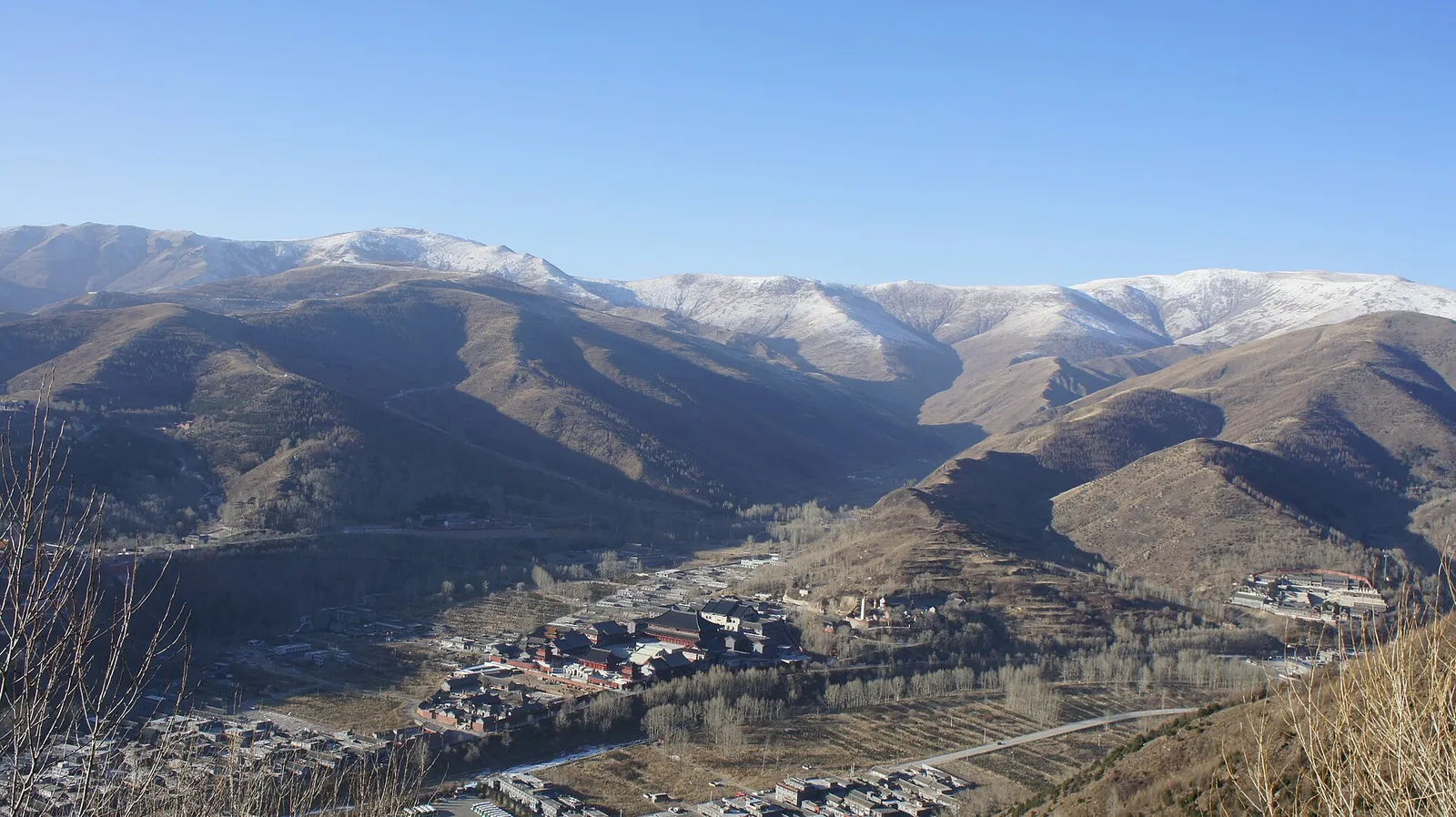
Wutai Shan, the ‘Five Terrace Mountain’, is the foremost of the four sacred Buddhist mountains of China and the one most fully shared by Chinese and Tibetan Buddhism. From at least the Tang dynasty it was identified with the Clear and Cool Mountain named in the Avatamsaka Sutra as the dwelling of Manjushri, bodhisattva of wisdom, and pilgrims came from India, Central Asia, Korea and Japan. Tibetans call it Riwo Tsenga, ‘Five-Peaked Mountain’. Chogyal Phagpa visited in 1257, and under the Yuan, Ming and Qing dynasties Tibetan lamas were installed in several of its monasteries.
The five peaks, bare rounded summits named for the four directions and the centre, enclose a high valley in northern Shanxi; the northern peak, at 3,061 metres, is the highest point in north China. The town of Taihuai at the centre, at about 1,700 metres, holds the main temples. Among them are Tayuan, whose great white stupa in Tibetan style, more than fifty metres tall, goes back to a Yuan-dynasty foundation of 1301; Xiantong, the oldest and largest; and Pusading, the ‘Bodhisattva Summit’, the chief Tibetan Buddhist monastery, reached by 108 steps and roofed in imperial yellow tiles.
Qing emperors made repeated pilgrimages, and the Mongols adopted the mountain as their principal holy place; Changkya Rolpai Dorje, the leading lama of the Qianlong court, spent his summers here and died on the mountain in 1786, and the Thirteenth Dalai Lama stayed for several months in 1908. Most monasteries were closed and damaged during the Cultural Revolution and reopened from the 1980s. Several dozen are now active, a number of them Tibetan Buddhist, and Tibetan and Mongol pilgrims again visit the five peaks. UNESCO inscribed Mount Wutai as a World Heritage cultural landscape in 2009.
Connections
7 linked records across the archive.
Sources
References consulted for this record.
- 01Mount Wutai — UNESCO World Heritage Centre
- 02Mount Wutai — Wikipedia
- 03Wen-shing Chou, Mount Wutai: Visions of a Sacred Buddhist Mountain (Princeton University Press, 2018)