FT·PLA·041Monastery
Erdene Zuu Monastery
Datefounded 1585
Earliest surviving Buddhist monastery in Mongolia, founded in 1585 beside the ruins of Karakorum after the Khalkha prince Abtai Khan met the Third Dalai Lama.
Also known asErdene Zuu · Erdeni Juu · Erdene Zuu Khiid · Erdeni Dzu
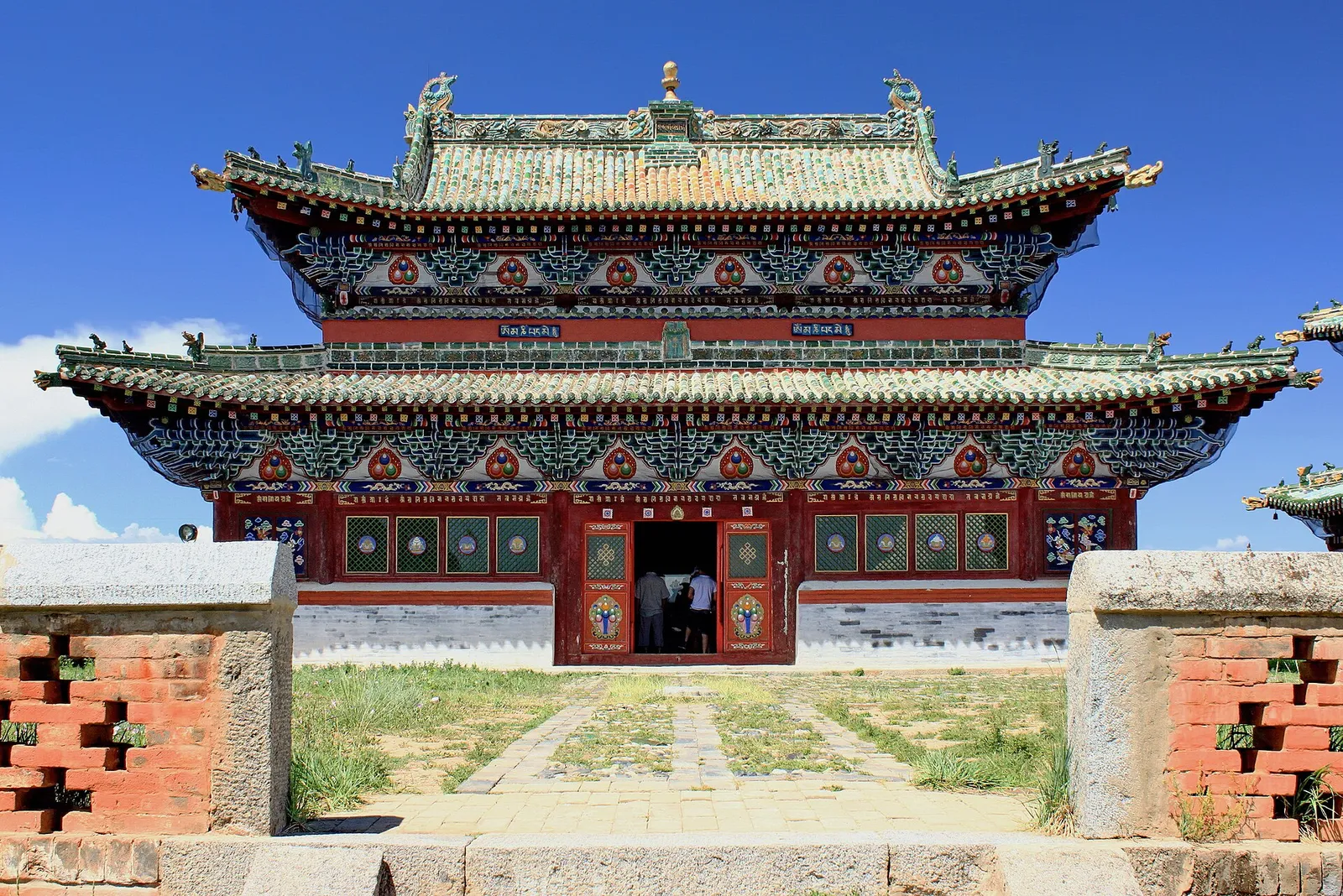
Erdene Zuu, ‘Jewel Lord’, is regarded as the oldest surviving Buddhist monastery in Mongolia. It was founded in 1585 by Abtai Sain Khan, ruler of the Khalkha Mongols, after he had travelled south to meet Sonam Gyatso, the Third Dalai Lama, and adopted Tibetan Buddhism. The monastery stands beside the site of Karakorum, the 13th-century capital of the Mongol empire, and stone from the ruined city was used in its walls. Abtai’s descendant Zanabazar became the first Jebtsundamba Khutugtu, head of Buddhism in Mongolia, and the monastery grew under the patronage of his line.
The compound is a square about 400 metres on a side, on the grassland of the Orkhon valley at roughly 1,460 metres, enclosed by a white wall set with stupas, intended to number 108. Of the many temples that once filled it, the oldest survive in the south-west corner: three halls in Chinese style with green-tiled roofs, known as the Three Zuu, which house images of the Buddha and his attendants. Nearby are the Golden Stupa, a small temple named for the Dalai Lama, and the Tibetan-style Lavrin temple, where services are held. Stone tortoises from Karakorum lie outside the walls.
Erdene Zuu was damaged in the wars between the Dzungars and the Khalkha in 1688 and rebuilt in the 18th century, when it is said to have held more than sixty temples and up to a thousand monks. In the late 1930s, during the anti-religious campaign under Choibalsan, most of its buildings were demolished and its monks killed or dispersed; the wall and a few temples were kept and became a museum. Religious services resumed in 1990. The site forms part of the Orkhon Valley Cultural Landscape, inscribed by UNESCO in 2004, and functions today as both museum and working Gelug monastery.
Connections
7 linked records across the archive.
Sources
References consulted for this record.
- 01Orkhon Valley Cultural Landscape — UNESCO World Heritage Centre
- 02Erdene Zuu Monastery — Wikipedia
- 03Christopher P. Atwood, Encyclopedia of Mongolia and the Mongol Empire (Facts on File, 2004)