FT·PLA·040Monastery
Tabo Monastery
Datefounded 996
Monastery in the Spiti valley founded in 996 under King Yeshe-Ö of Guge, whose main temple preserves a complete sculpted and painted mandala of the 11th century.
Also known asTabo · Tabo Chos-khor · Tabo Gompa · Tabo Choskhor
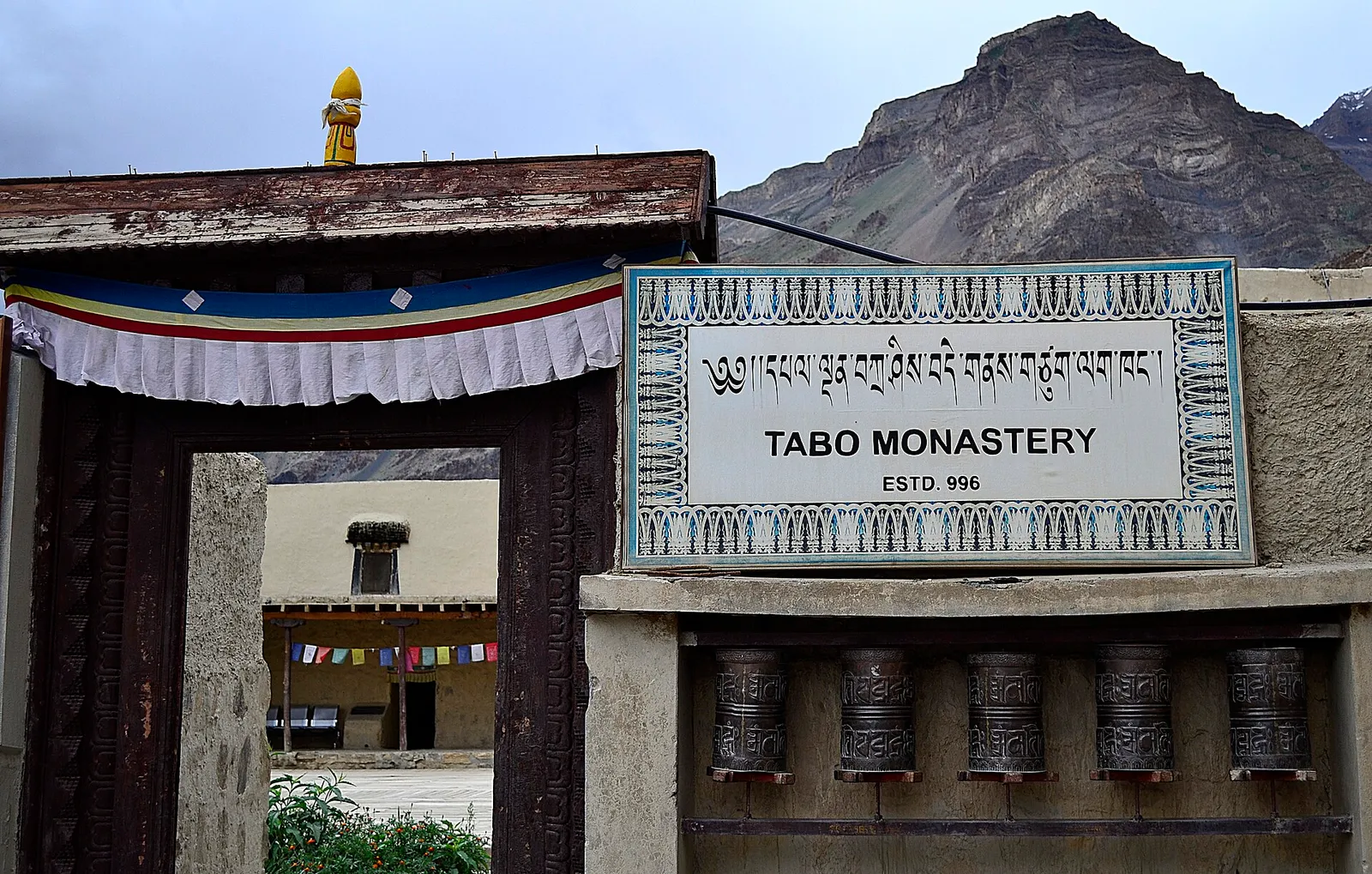
Tabo is the oldest continuously functioning Buddhist monastery in the Indian Himalaya and the best preserved foundation of the kingdom of Guge. An inscription in its main temple records that it was founded in the Fire Monkey year, 996, by the royal monk Yeshe-Ö, and renovated forty-six years later by his grand-nephew Jangchub Ö; tradition also associates it with the translator Rinchen Zangpo. It thus dates from the first years of the Buddhist revival in western Tibet and documents its art more fully than any site in Tibet itself, where comparable temples were lost.
The monastery is a walled compound of nine low mud-brick temples and many stupas on the flat floor of the Spiti valley, at about 3,280 metres. The main temple, the Tsuglagkhang, is arranged as a three-dimensional mandala of the Buddha Vairochana: a four-bodied image of Vairochana sits at the rear of the assembly hall, and thirty-two life-size clay deities are fixed along the walls above head height. Below them, paintings of the 1040s narrate the pilgrimage of Sudhana and the life of the Buddha, with long wall inscriptions. Meditation caves pierce the cliff above the village.
Tabo has belonged to the Gelug school for some centuries and has a community of several dozen monks. An earthquake in 1975 damaged the old temples, and a new assembly hall was built in 1983, where the Fourteenth Dalai Lama gave the Kalachakra initiation that year and again in 1996, the monastery’s millennium. The old temples are protected by the Archaeological Survey of India; rain damage to the earthen roofs and walls is a recurring problem. Tabo has been studied in depth by an Austrian-led team under Deborah Klimburg-Salter, whose Tabo: A Lamp for the Kingdom appeared in 1997.
Connections
9 linked records across the archive.
Sources
References consulted for this record.
- 01Tabo Monastery — Wikipedia
- 02Deborah E. Klimburg-Salter, Tabo: A Lamp for the Kingdom. Early Indo-Tibetan Buddhist Art in the Western Himalaya (Skira, 1997)
- 03Giuseppe Tucci, Indo-Tibetica III.1: I templi del Tibet occidentale e il loro simbolismo artistico (Reale Accademia d'Italia, 1935)