FT·PLA·036Monastery
Labrang
བླ་བྲང་བཀྲ་ཤིས་འཁྱིལ
Wyliebla brang bkra shis 'khyilDatefounded 1709
Largest monastery of Amdo, founded in 1709 at Sangchu (Xiahe) by the First Jamyang Zhepa, with six colleges and a three-kilometre circuit of prayer wheels.
Also known asLabrang Monastery · Labrang Tashikhyil · Labrang Tashi Khyil · Labuleng Si
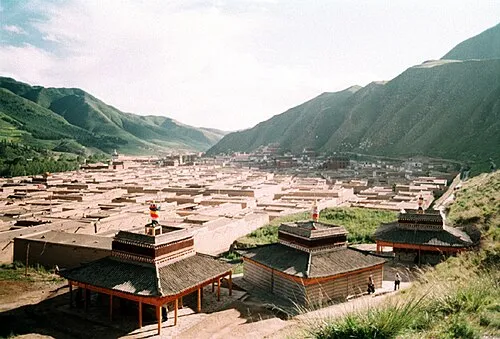
Labrang Tashikhyil is the foremost monastic university of Amdo and one of the six great monasteries of the Gelug school. It was founded in 1709 by Ngawang Tsondru (1648–1721), the First Jamyang Zhepa, a native of the region who had become one of the leading scholars of Drepung, at the invitation of a local Mongol prince. His textbooks became the curriculum of Drepung’s Gomang college and of Labrang itself. Under his successors the monastery governed a wide territory of farmers and nomads and stood at the meeting point of Tibetan, Mongol, Chinese and Muslim societies.
The monastery lines the north bank of the Sangchu, or Daxia river, at about 2,900 metres in a valley of grassland and pine. It has six colleges: Thosamling for philosophy, upper and lower tantric colleges, and colleges of Kalachakra, medicine and Hevajra, each with its own assembly hall. Among dozens of other buildings are the great assembly hall, the gilded Maitreya temple, the residences of the Jamyang Zhepa and other reincarnate lamas, and the tall Gongtang stupa by the river. A covered gallery of well over a thousand prayer wheels follows most of the three-kilometre pilgrim circuit around the walls.
Labrang housed up to four thousand monks before it was closed in 1958, when many were arrested during the suppression of revolt in Amdo. Buildings were damaged or put to other uses in the following two decades. The monastery reopened in 1980 and has been extensively restored; the great assembly hall, burned in 1985, was rebuilt by 1990. Well over a thousand monks now study here, the largest community outside the Tibet Autonomous Region, under numerical limits and official supervision. Monks from Labrang took part in the protests of 2008. Its festivals, especially the Monlam of the first month, draw pilgrims from across Amdo.
Connections
17 linked records across the archive.
Sources
References consulted for this record.
- 01Labrang Monastery — Wikipedia
- 02Paul Kocot Nietupski, Labrang Monastery: A Tibetan Buddhist Community on the Inner Asian Borderlands, 1709–1958 (Lexington Books, 2011)
- 03Charlene Makley, The Violence of Liberation: Gender and Tibetan Buddhist Revival in Post-Mao China (University of California Press, 2007)