FT·PLA·004City & Region
Rebkong
རེབ་གོང
Wyliereb gong
Valley and town in eastern Amdo, home of Rongwo monastery and of the artist villages whose thangka painting and sculpture are known as Rebkong art.
Also known asRebgong · Repkong · Tongren · Rongwo Monastery · Regong
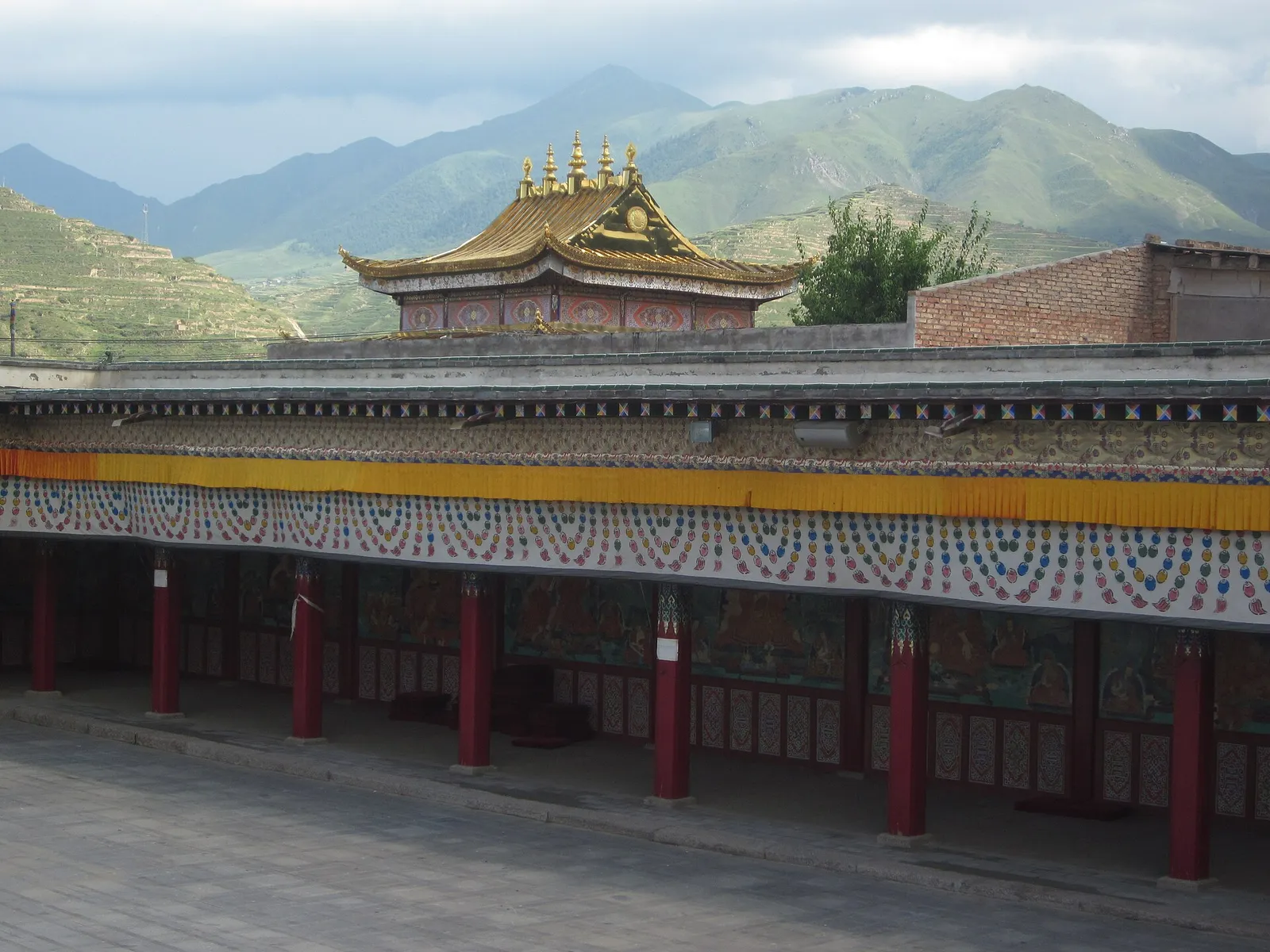
Rebkong is the Tibetan name for the valley of the Guchu, or Rongwo river, a southern tributary of the Yellow River in eastern Amdo, and for its chief town, known in Chinese as Tongren. Tibetans call it a golden valley and regard it as a cradle of learning: it produced the poet and yogin Shabkar Tsokdruk Rangdrol (1781–1851) and the modernist scholar Gendun Chopel (1903–1951). The valley is best known for its painters and sculptors, whose workshops have supplied monasteries across Tibet, Mongolia and China for some three hundred years.
The town stands at about 2,500 metres around Rongwo Gonchen, a large Gelug monastery of ochre and white halls. It was founded in 1301, according to the usual account, as a Sakya house by Samten Rinchen and was converted to the Gelug school under Shar Kalden Gyatso (1607–1677), whose reincarnations lead it. A few kilometres downstream lie the artist villages of Sengeshong, called Wutun in Chinese, Gomar, Nyentok and Kasar, each with its own temple. Their thangkas are known for dense detail, bright mineral colour and lavish use of gold; appliqué, clay sculpture and wood carving are also practised.
Religious life in Rebkong is unusually varied. Alongside the Gelug monasteries there is a large community of Nyingma ngakpa, married tantric practitioners, and several Bon villages; in summer the villages hold the Lurol festival for the mountain gods. Monasteries were closed in 1958 and the painters could not work openly during the Cultural Revolution, but the tradition recovered quickly after 1980, and in 2009 UNESCO inscribed Regong arts on its list of intangible cultural heritage. Demand from collectors has since turned painting into a major local industry. The town was a centre of protests in 2008 and 2012.
Connections
8 linked records across the archive.
Sources
References consulted for this record.
- 01Rongwo Monastery — Wikipedia
- 02Regong arts — Wikipedia
- 03Tongren, Qinghai — Wikipedia
- 04Yangdon Dhondup, Ulrich Pagel and Geoffrey Samuel (eds.), Monastic and Lay Traditions in North-Eastern Tibet (Brill, 2013)