FT·MAS·029Kagyu Master
Milarepa
མི་ལ་རས་པ
Wyliemi la ras paDatec. 1040–1123
Tibet’s most beloved yogin and poet, who turned from sorcery and murder to a life of solitary meditation and is said to have attained awakening in a single lifetime.
Also known asJetsun Milarepa · Mila Repa · Mila Shepa Dorje · Thopaga
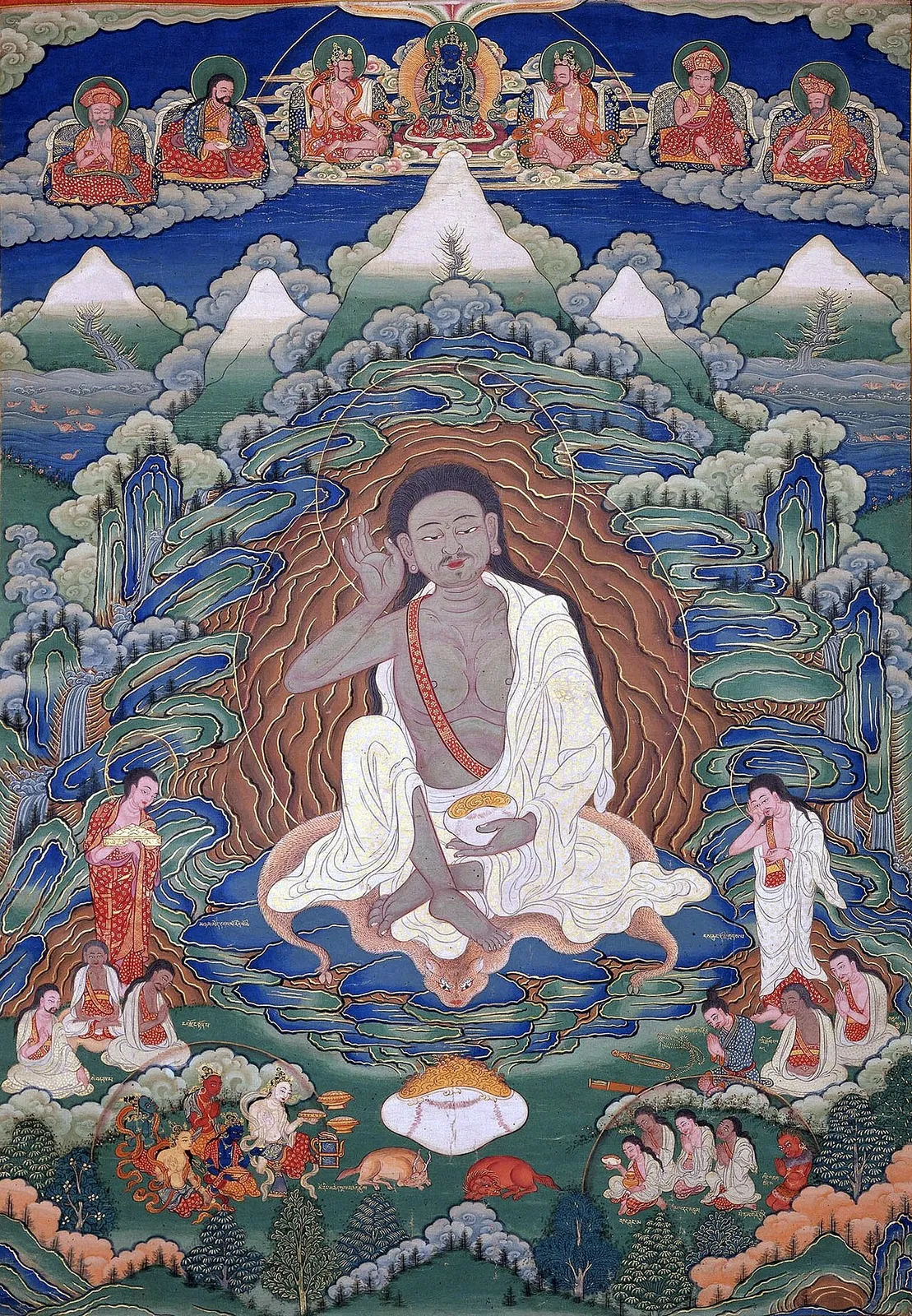
Milarepa, ‘Mila the cotton-clad’, is the best-known religious figure in Tibetan culture after the Buddha and Padmasambhava. His dates are uncertain; 1040 to 1123 and 1052 to 1135 are both given. He was born in Gungthang near the Nepalese border. According to his life story, his father’s early death left the family at the mercy of an uncle and aunt who seized their property, and at his mother’s urging he learned black magic and brought down their house, killing many people.
Remorse drove him to seek the Dharma, and he came to Marpa in Lhodrak. Marpa refused to teach him, made him build and demolish a series of stone towers, and drove him to despair before granting initiation; the ordeal is understood as purifying his crimes. Milarepa then spent the rest of his life in mountain caves in southern Tibet, practising inner heat (tummo) and Mahamudra, wearing a single cotton cloth and, in one famous period, living on nettles until his body turned green. He taught through spontaneous songs.
The Life of Milarepa and the Hundred Thousand Songs, compiled by Tsangnyon Heruka in 1488 from earlier collections, are classics of Tibetan literature and the source of the story as usually told. His students included the monk Gampopa, through whom the Kagyu school took institutional form, and the yogin Rechungpa. He is depicted seated on an antelope skin with his right hand cupped to his ear. His caves at Lapchi, Chubar, Drakar Taso and Nyanang remain pilgrimage sites.
Connections
21 linked records across the archive.
Sources
References consulted for this record.
- 01Milarepa — The Treasury of Lives
- 02Milarepa — Wikipedia
- 03Milarepa — Rigpa Shedra Wiki
- 04Tsangnyön Heruka, The Life of Milarepa, trans. Andrew Quintman (Penguin Classics, 2010)