FT·SYM·017Emblems & Offerings
Khata
ཁ་བཏགས
Wyliekha btags
A long scarf of white silk presented in greeting, farewell, congratulation and worship, expressing the sincerity and good wishes of the giver.
Also known asKhatak · Katak · Kha-btags · Hada · Ceremonial Scarf · Offering Scarf
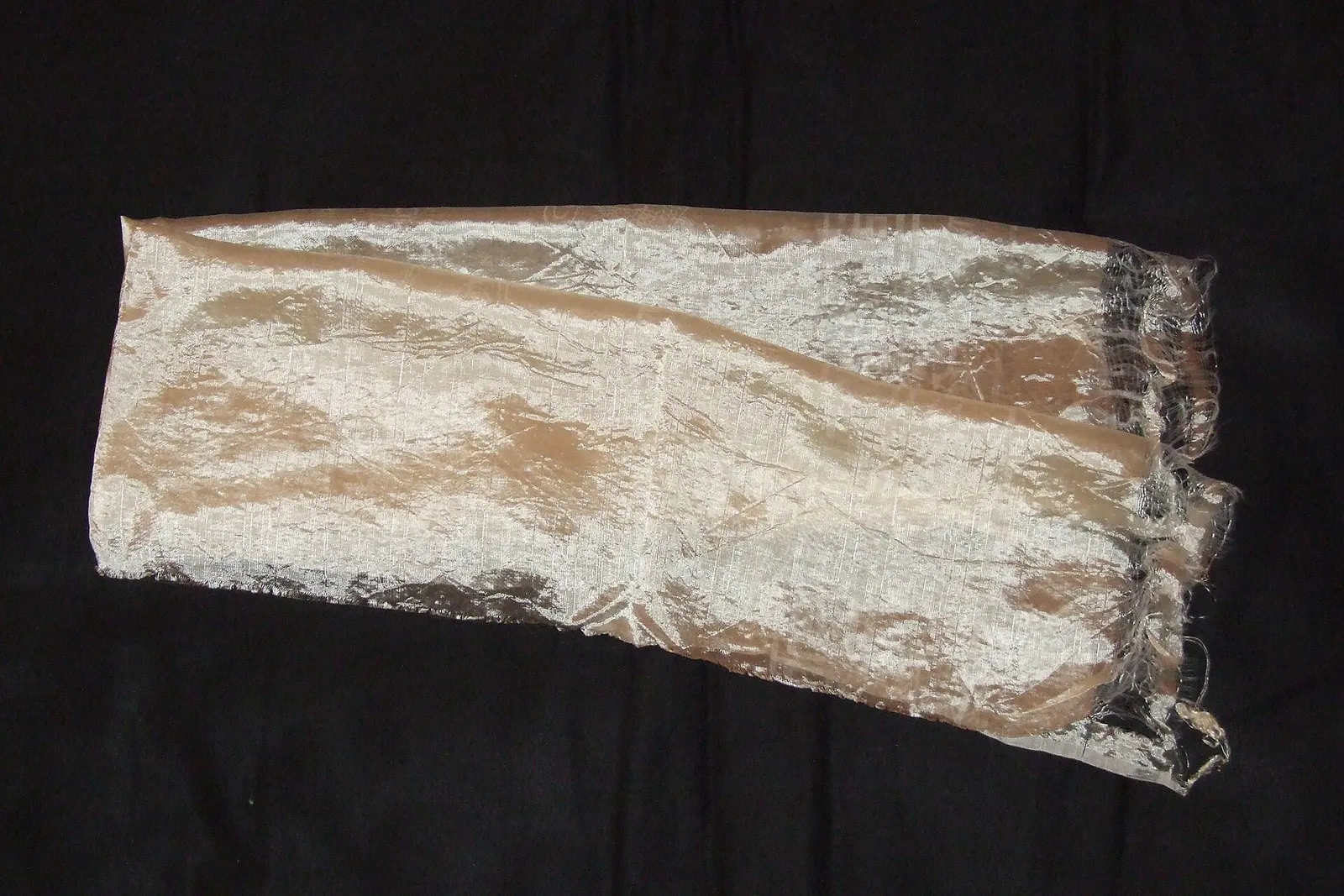
The khata is the ceremonial scarf exchanged throughout the Tibetan cultural world and in Mongolia, Bhutan and the Himalayan regions. It is given on meeting and parting, at births, weddings, funerals and graduations, to teachers and officials, and to images, stupas and sacred sites. Hardly any formal gift or request is made without one. Its white colour stands for the pure intention of the giver, and the act takes the place of the handshake or bow of other cultures as the basic form of courtesy. In Mongolia the usual colour is sky blue.
A khata is a narrow rectangle of loosely woven cloth with fringed ends, from under a metre to several metres long. The finest are silk, with woven patterns of the Eight Auspicious Symbols and phrases of good fortune such as tashi delek. Ordinary ones are cotton or, today, polyester. Tibetans grade them by quality, with long patterned silk scarves reserved for high lamas and formal occasions. Before presentation the scarf is folded lengthwise into a double layer with the open edges toward the recipient. Sets in five colours, blue, white, red, green and yellow, are used for deities and in Mongolian custom.
The giver holds the scarf across both open hands and bows slightly. To a superior or a lama it is offered at hand level, and the lama commonly returns it by placing it round the giver’s neck as a blessing. Between equals scarves are exchanged, and to a junior the scarf is draped round the neck. Scarves are tied to statues, thrones, door handles, prayer-flag poles and the cairns at mountain passes, and thrown toward a departing vehicle or a revered teacher. Historically most silk khatas were woven in China for the Tibetan market.
Connections
6 linked records across the archive.
Sources
References consulted for this record.
- 01Khata — Wikipedia
- 02Robert Beer, The Encyclopedia of Tibetan Symbols and Motifs (Shambhala, 1999)