FT·SCH·007Major School
Bon
བོན
WyliebonDateorganised form from the 10th–11th century
Tibet’s own religious tradition, tracing its teachings to Tonpa Shenrab, with its own canon, monasteries, nine ways of practice and Dzogchen lineages.
Also known asBön · Yungdrung Bon · Bonpo · Eternal Bon · Bön religion
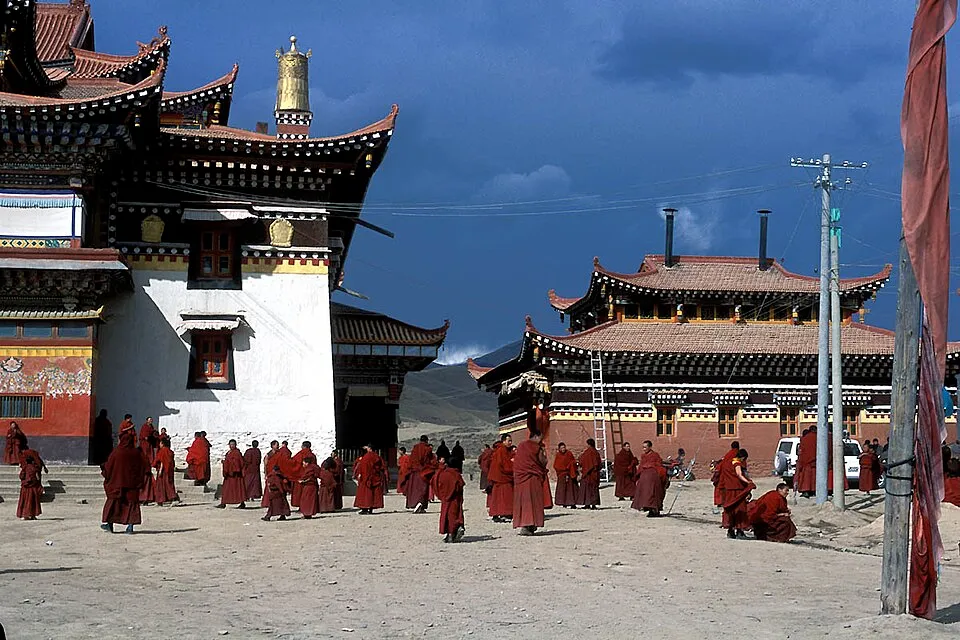
Bön is the religious tradition that Tibetans regard as native to their land and as older than Buddhism. Its followers, the Bönpo, hold that it was taught by the buddha Tonpa Shenrab in the land of Olmo Lungring, spread to the kingdom of Zhangzhung in what is now western Tibet, and reached central Tibet before the Buddhist kings, under whom it was twice suppressed. The form practised today is called Yungdrung Bön, ‘eternal Bön’. Historians distinguish the priests called bon and shen who served the imperial court, the organised religion documented from the tenth and eleventh centuries, and later developments known as New Bön.
Bön presents a complete path to buddhahood. Its teachings are arranged as nine ways: four ‘causal’ ways concerned with divination, astrology, healing and funerary ritual, and five ‘resultant’ ways covering lay and monastic ethics, tantra and, as the summit, Dzogchen, the Great Perfection. Three Dzogchen systems are transmitted: the Oral Transmission of Zhangzhung, held to descend unbroken from Zhangzhung masters; the A-tri, ‘guidance of the letter A’; and a third known simply as Dzogchen. The canon comprises a Kangyur of the founder’s words, in about 180 volumes, and a Katen of commentaries, in about 300. Bönpos circumambulate counter-clockwise and recite mantras such as om matri muye sale du.
The treasure revealer Shenchen Luga recovered key scriptures in 1017, and Nyammed Sherab Gyaltsen founded Menri in 1405 as the mother monastery, later joined by Yungdrung Ling. Bön remained strong in Kham, Amdo, Gyalrong and parts of Nepal such as Dolpo. Over a millennium Bön and Buddhism shaped one another deeply. In exile, Menri was re-established at Dolanji in Himachal Pradesh, and Bön is represented in the Tibetan parliament in exile alongside the four Buddhist schools. Its head is the Menri Trizin, the abbot of Menri.
Connections
28 linked records across the archive.
Sources
References consulted for this record.
- 01Bon — Wikipedia
- 02Per Kvaerne, The Bon Religion of Tibet: The Iconography of a Living Tradition (Serindia, 1995)
- 03David L. Snellgrove, The Nine Ways of Bon: Excerpts from gZi-brjid (Oxford University Press, 1967)
- 04Samten G. Karmay, The Arrow and the Spindle: Studies in History, Myths, Rituals and Beliefs in Tibet (Mandala Book Point, 1998)