FT·PLA·012Temple
Ramoche
ར་མོ་ཆེ
Wyliera mo cheDate7th century
Sister temple of the Jokhang in northern Lhasa, traditionally founded by the Chinese princess Wencheng and later home of the Upper Tantric College.
Also known asRamoche Temple · Ramoche Tsuglagkhang · Xiaozhao Si
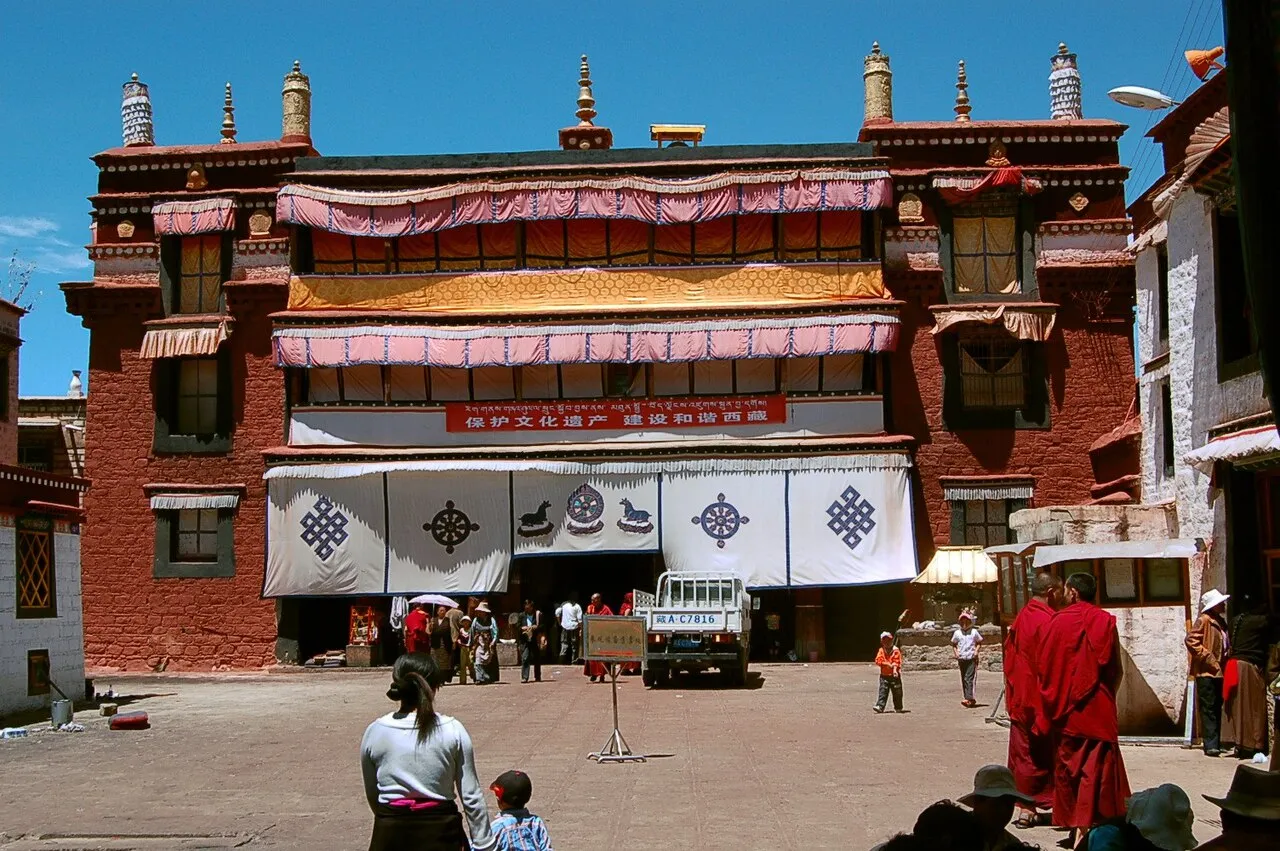
Ramoche is the second of Lhasa’s two royal temples, founded according to tradition in the 7th century at the same time as the Jokhang. The histories credit it to Wencheng, the Chinese princess who married the emperor Songtsen Gampo, and say that it was built to house the Jowo Shakyamuni image she brought from the Tang capital. In a later generation the two temples exchanged their principal statues. Ramoche has since held the Jowo Mikyo Dorje, an image of the Buddha as a boy of eight, associated with the Nepalese queen Bhrikuti.
The temple stands about a kilometre north of the Jokhang and, unusually, faces east, which tradition explains as the princess looking toward her homeland. A gatehouse and courtyard lead to an assembly hall of three storeys, a circumambulation corridor lined with prayer wheels, and the inner sanctum of the Jowo. The original building was lost to fire, and the present structure dates in the main from a rebuilding of 1474. Soon afterwards it became the seat of Gyuto, the Upper Tantric College, where Gelug monks who had completed their philosophical studies trained in tantric ritual and its deep-voiced chant.
Ramoche was badly damaged in 1959 and during the Cultural Revolution, and the Jowo Mikyo Dorje was broken in two. The halves were recovered separately, one in Lhasa and one in Beijing, and rejoined in the 1980s; the temple was restored and reopened in 1986. It is again an active Gelug temple and a regular stop for pilgrims after the Jokhang. The Gyuto college was re-established in exile in India and now has its main seat at Sidhbari near Dharamsala. The unrest of March 2008 in Lhasa began in the streets around Ramoche.
Connections
8 linked records across the archive.
Sources
References consulted for this record.
- 01Ramoche Temple — Wikipedia
- 02Gyuto Order — Wikipedia
- 03André Alexander, The Temples of Lhasa: Tibetan Buddhist Architecture from the 7th to the 21st Centuries (Serindia, 2005)