FT·MAS·012Indian Master
Nagarjuna
ཀླུ་སྒྲུབ
Wylieklu sgrubSanskritNāgārjunaDatec. 150–250 CE
South Indian philosopher of about the second century, founder of the Madhyamaka or Middle Way school, whose analysis of emptiness underlies all Tibetan Buddhist thought.
Also known asArya Nagarjuna · Ludrup · Lopon Ludrup · Acharya Nagarjuna
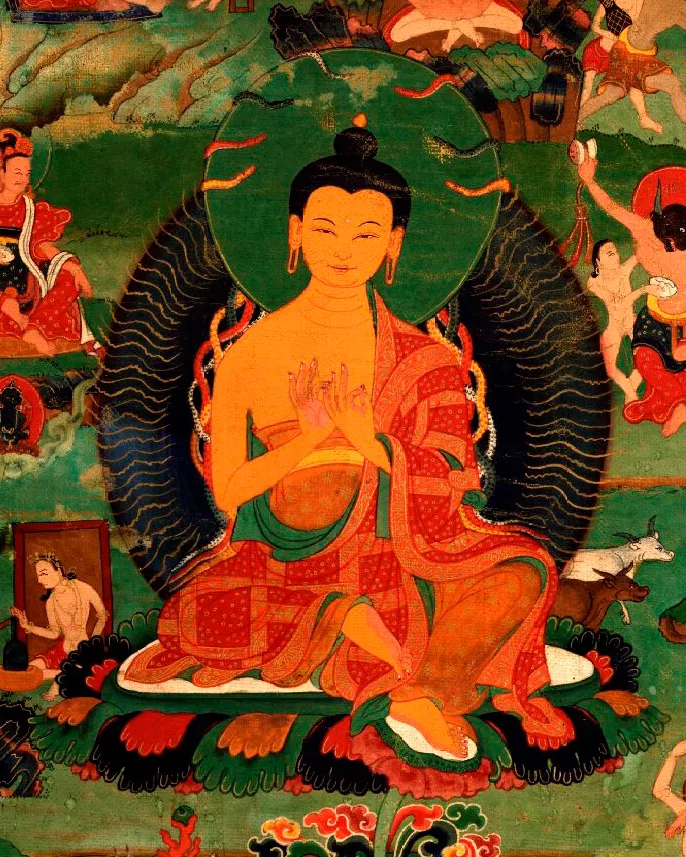
Nagarjuna is the most influential philosopher of Mahayana Buddhism. He probably lived in southern India in the second or third century CE, perhaps under the patronage of a Satavahana king to whom two of his letters are addressed; little else about his life is known with certainty. His writings founded the Madhyamaka, the ‘Middle Way’ school. In Tibet he heads the list of the Six Ornaments, the great Indian commentators, and every school claims to present his final view.
His principal work, the Mulamadhyamakakarika or ‘Root Verses on the Middle Way’, argues that nothing possesses svabhava, an intrinsic and independent nature. Because all things arise in dependence on causes, parts and conceptual designation, they are empty of such a nature; emptiness and dependent arising are two descriptions of one fact. This steers between the extremes of eternal existence and nihilistic non-existence. He distinguishes conventional truth, the everyday world that functions, from ultimate truth, its emptiness, and holds that both must be understood for liberation.
Legend says he recovered the Perfection of Wisdom sutras from the realm of the nagas, serpent spirits, hence his name. Tibetan tradition also attributes to him tantric works on Guhyasamaja and on alchemy, which historians assign to a later author of the same name. His Letter to a Friend, Precious Garland and hymns are widely taught, and the Root Verses, read through Chandrakirti and other commentators, remain a core text in the monastic colleges of all Tibetan schools.
Connections
17 linked records across the archive.
Sources
References consulted for this record.
- 01Nāgārjuna — Stanford Encyclopedia of Philosophy
- 02Nagarjuna — Wikipedia
- 03Nagarjuna — Rigpa Shedra Wiki
- 04Jan Westerhoff, Nāgārjuna's Madhyamaka: A Philosophical Introduction (Oxford University Press, 2009)