FT·DEI·055Dharma Protector
Begtse
བེག་ཙེ
Wyliebeg tse
The red armoured protector ‘Great Coat of Mail’, who raises a scorpion-hilted sword and clutches a heart, bow and arrow; guardian of the Hayagriva cycle, popular in Mongolia.
Also known asBegtse Chen · Chamsing · Jamsaran · Beg-tse · Begtse Chamsing · Great Coat of Mail
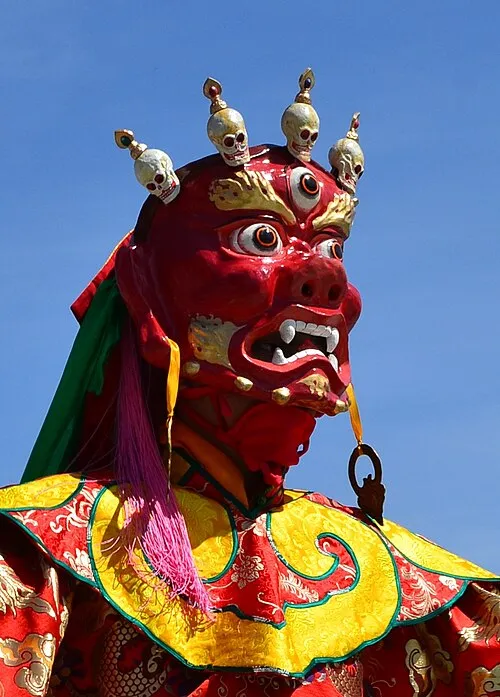
Begtse Chen, ‘Great Coat of Mail’, also called Chamsing, ‘Brother and Sister’, after the pair he forms with his sister, is a red warrior protector attached to the Hayagriva cycle of practice. He ranks high among the protectors of the Sakya school and was later adopted by the Gelug, becoming very popular in Mongolia from the seventeenth century under the name Jamsaran. An older view that he was a Mongolian war god converted by the Third Dalai Lama has been set aside by research showing that his rituals were known in Tibet centuries earlier.
He is red, with one face, three eyes and two arms, and has the appearance of a tsen spirit dressed as a Tibetan warrior in a coat of mail, with a crown of five skulls and a garland of heads. The right hand raises a sword whose hilt is shaped like a scorpion. The left hand clutches a fresh heart to his breast while holding a bow and arrow in the crook of the elbow, and a lance with a banner leans against the shoulder. He stands with the right foot on the corpse of a horse and the left on the corpse of a man, surrounded by flames.
Two companions attend him: his sister, the Goddess of Life, who has a blue body and red face, rides a bear and brandishes a sword, and the red Master of Life, who rides a wolf. Most surviving paintings and sculptures were made in a Gelug context, and many are Mongolian; Begtse is one of the masked figures of the Mongolian tsam dance. He is included in a popular list of eight great protectors. Because both are red warriors, he is sometimes confused with the Nechung protector Dorje Drakden.
Connections
8 linked records across the archive.
Sources
References consulted for this record.
- 01Begtse Chen Main Page — Himalayan Art Resources
- 02Begtse — Wikipedia
- 03René de Nebesky-Wojkowitz, Oracles and Demons of Tibet (Mouton, 1956)