FT·SYM·065Sacred Music
Gyaling
རྒྱ་གླིང
Wyliergya gling
A double-reed oboe of wood and metal, played in pairs with continuous breathing, that carries the melody in Tibetan monastic music.
Also known asGya Ling · Tibetan Oboe · Tibetan Shawm · Rgya Gling
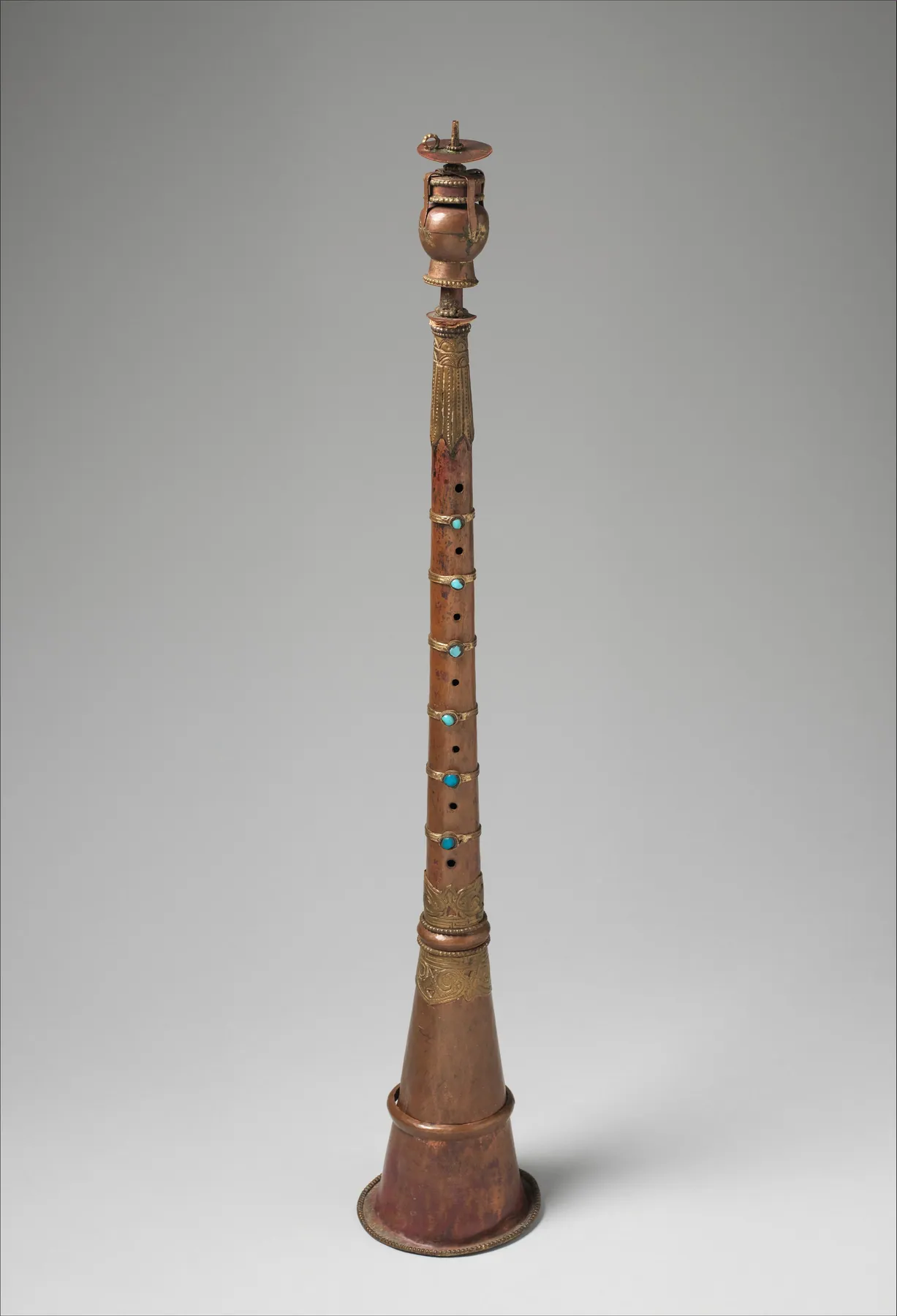
The gyaling is the shawm of the Tibetan monastic orchestra and its principal melodic instrument. The name is translated as Indian flute or Chinese flute, the first syllable being ambiguous, and the instrument belongs to the family of conical double-reed pipes found from the Middle East to China. Its bright, penetrating sound is associated with peaceful deities and with honour: gyaling players lead processions, escort lamas to the throne, and play during offerings and at the opening and close of rituals.
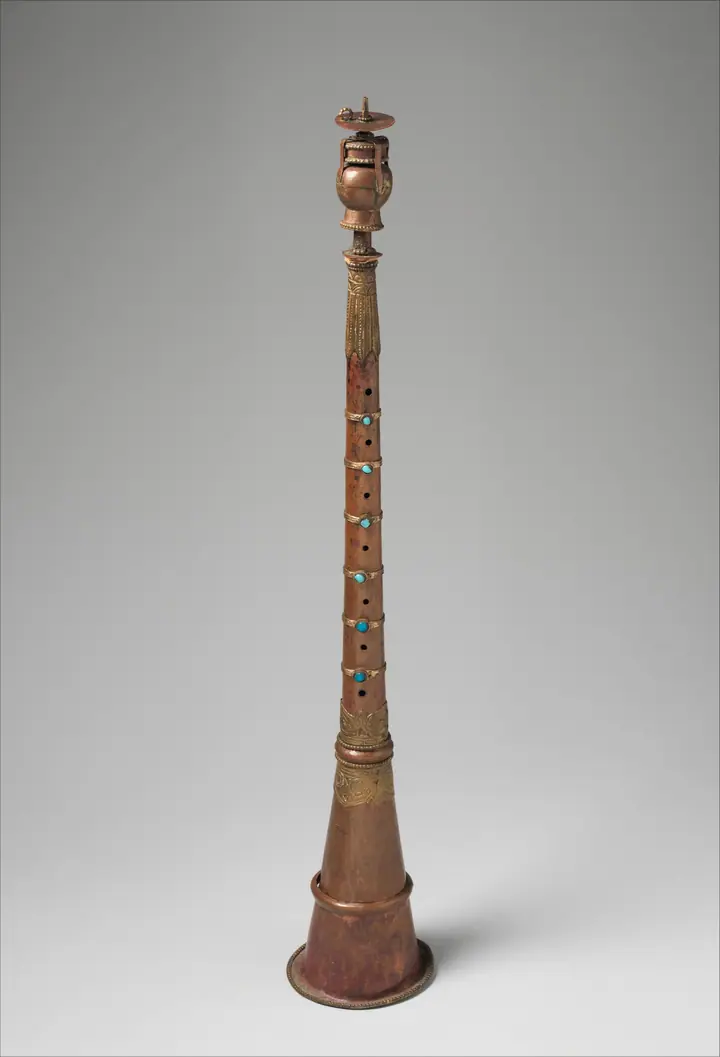
The body is a conical tube of hardwood with seven finger holes on the front and one thumb hole behind. It is bound with metal rings, frequently set with turquoise, coral or coloured glass. A wide flaring bell of copper or brass, often gilded and embossed, is fitted to the lower end. At the top a small double reed cut from marsh reed sits on a metal tube with a disc against which the player presses the lips. Players use circular breathing, inhaling through the nose while pushing air from the cheeks, so that the melody is unbroken.
Gyaling are played in pairs in near unison, their slight differences of pitch giving a shimmering quality. Melodies are slow, ornamented with trills and slides, and are learned by ear from a teacher, supported in some traditions by written notation. Each monastery and ritual cycle has its own tunes. The instrument is used in all schools of Tibetan Buddhism and in Bön, and by related communities in Bhutan, Ladakh, Nepal and Mongolia. Makers in Tibet, the Kathmandu Valley and the Tibetan settlements in India continue to produce it.
In the collection
1 work in the collection relate to Gyaling.
Connections
8 linked records across the archive.
Sources
References consulted for this record.
- 01Gyaling — Wikipedia
- 02Ritual Object: Musical Instruments — Himalayan Art Resources
- 03Mireille Helffer, Mchod-rol: Les instruments de la musique tibétaine (CNRS Éditions, 1994)