FT·SCI·040Science Dialogue
Tibetan Plateau, the Third Pole
The Tibetan Plateau, the world’s highest and largest, holds the greatest store of ice outside the polar regions and feeds the major rivers of Asia.
Also known asThird Pole · Tibetan Plateau · Asian Water Tower · Qinghai-Tibet Plateau · Roof of the World
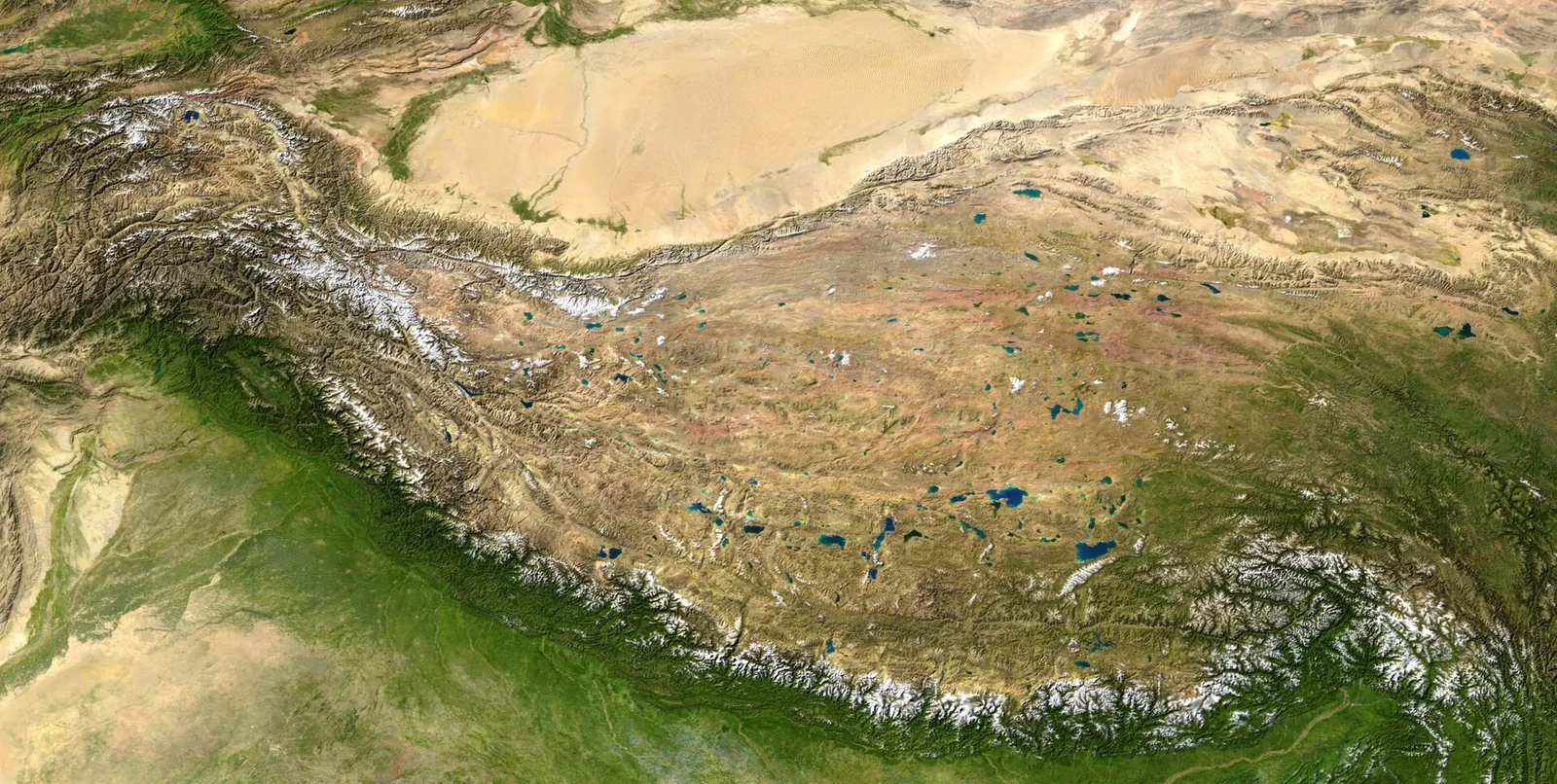
This entry summarises modern earth science about Tibet’s physical setting. The Tibetan Plateau covers about 2.5 million square kilometres at an average elevation above 4,500 metres, bounded by the Himalaya to the south, the Karakoram to the west and the Kunlun and Qilian ranges to the north. It was raised by the collision of the Indian and Eurasian plates, which began some fifty to fifty-five million years ago and continues today.
Scientists call the plateau and its surrounding ranges the Third Pole because they hold more ice than anywhere outside the Arctic and Antarctic, in tens of thousands of glaciers. They also call it the Asian Water Tower. The Yellow River, Yangtze, Mekong, Salween, Brahmaputra, Indus and Sutlej all rise on the plateau, several of them near Mount Kailash, and their basins support a large share of the population of Asia, by one recent estimate almost two billion people.
The region is warming faster than the global average. A 2012 study in Nature Climate Change led by Yao Tandong, covering more than 7,000 glaciers, found most to be shrinking, fastest in the Himalaya, while some in the Karakoram and Pamir were stable or growing. Thawing permafrost, expanding lakes and changing river flow are active subjects of research. Tibetan tradition, which regards many of these mountains and lakes as sacred, has its own long record of attention to the landscape.
Connections
7 linked records across the archive.
Sources
References consulted for this record.
- 01Tibetan Plateau — Wikipedia
- 02Yao et al., Different glacier status with atmospheric circulations in Tibetan Plateau and surroundings — Nature Climate Change 2 (2012)
- 03Tibetan glaciers shrinking rapidly — Nature News, 2012
- 04Yao et al., The imbalance of the Asian water tower — Nature Reviews Earth and Environment 3 (2022)