FT·SCI·015Cosmology
Abhidharma Cosmology
ཆོས་མངོན་པ
Wyliechos mngon paSanskritAbhidharmaDate4th–5th century text
Abhidharma cosmology is the classical Buddhist model of the universe, set out by Vasubandhu, with Mount Meru at the centre of each of countless world systems.
Also known asAbhidharmakosha cosmology · Buddhist cosmology · Ngonpa cosmology · Meru world system · Trichiliocosm
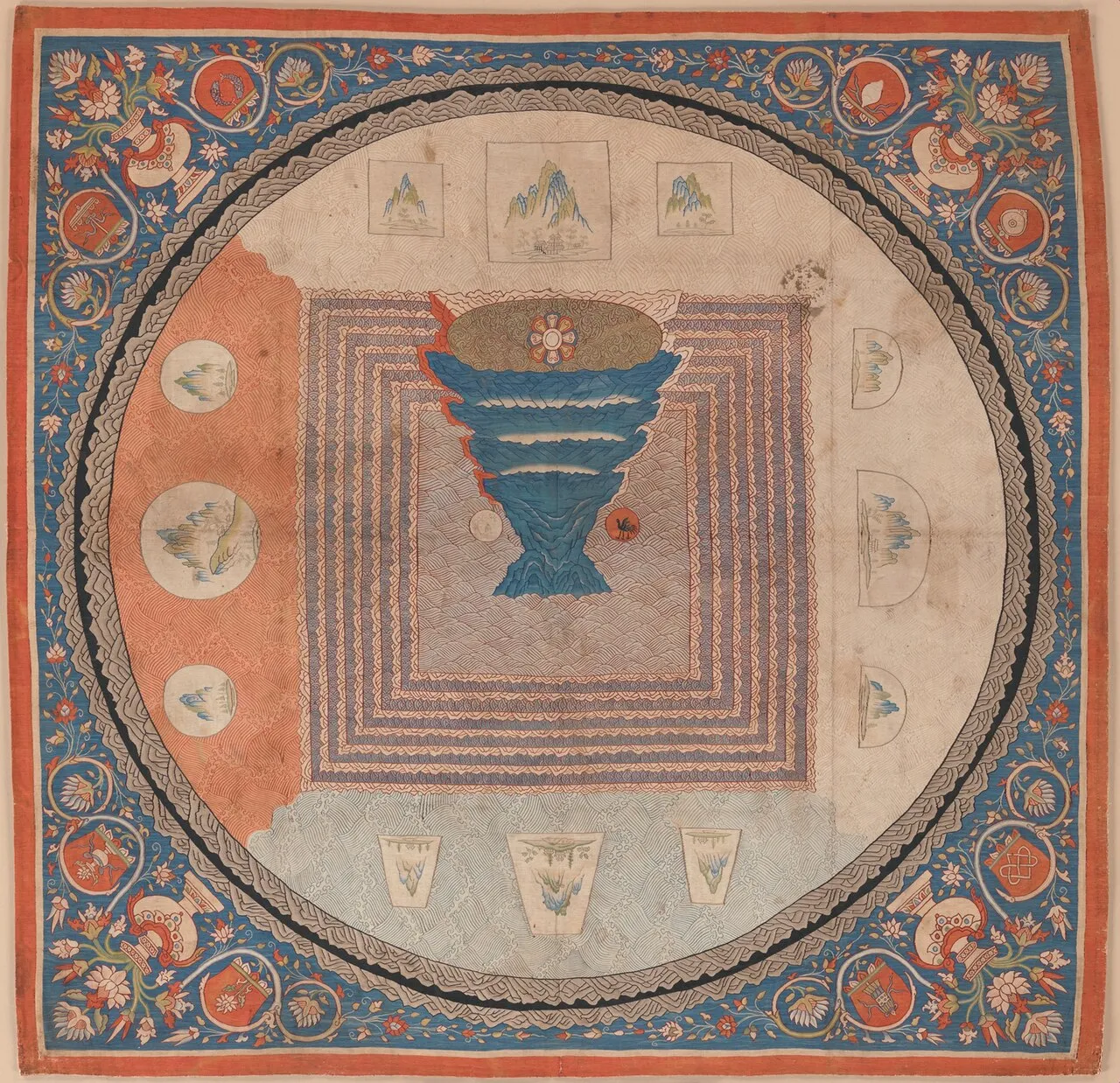
The cosmology of the Abhidharma is the standard picture of the universe studied in Tibetan monastic colleges. Its main source is the third chapter of the Abhidharmakosha, the Treasury of Abhidharma, composed by the Indian master Vasubandhu in the fourth or fifth century. The text is one of the five great subjects of the Gelug curriculum and is studied in every Tibetan school, so that generations of scholars have known its measurements by heart.
A world system rests on a disc of wind, above which lie water and a golden ground. At the centre stands Mount Meru, encircled by seven ranges and seas, then four continents and an outer wall of iron mountains. Beings occupy three realms, of desire, form and formlessness, arranged from hells below the earth to heavens above the mountain. A thousand such worlds make a small universe, and a thousand cubed, a billion, make the ‘great thousandfold’ universe, of which there are countless.
Time is cyclical. Each universe passes through four phases of formation, duration, destruction and emptiness, together making one great aeon. Buddhist writers treated the system as a map of the conditions of rebirth as much as a geography. Tibetan authors such as Jamgon Kongtrul noted that different scriptures give different cosmologies for different audiences. The Fourteenth Dalai Lama has written that its physical details must yield to modern astronomy, while its vision of many worlds and vast timescales remains instructive.
Connections
8 linked records across the archive.
Sources
References consulted for this record.
- 01Buddhist cosmology — Wikipedia
- 02Alexander Berzin, Buddhist Cosmology in Abhidharma and Kalachakra — Study Buddhism
- 03Jamgon Kongtrul, Myriad Worlds: Buddhist Cosmology in Abhidharma, Kalacakra and Dzog-chen (Snow Lion, 1995)