FT·PLA·007Palace & Fortress
Potala Palace
ཕོ་བྲང་པོ་ཏ་ལ
Wyliepho brang po ta laSanskritPotalakaDatebuilt 1645–1694
Winter palace of the Dalai Lamas on Marpo Ri in Lhasa, begun in 1645 by the Fifth Dalai Lama and seat of the Tibetan government until 1959.
Also known asPotala · Tse Potala · Podrang Potala · Budala Gong
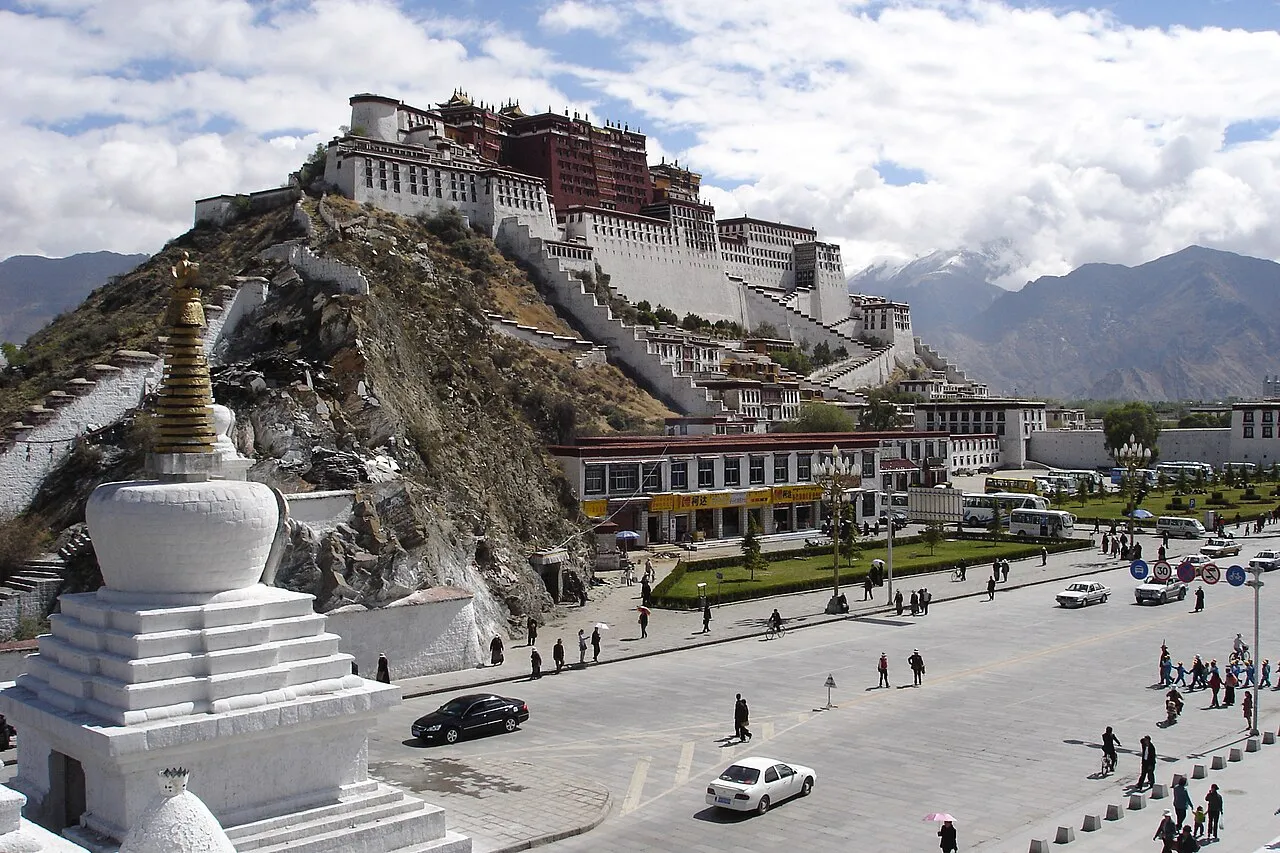
The Potala Palace is the former winter residence of the Dalai Lamas and was the seat of the Tibetan government from the 17th century until 1959. It is named after Mount Potalaka, the abode of Avalokiteshvara, the bodhisattva of compassion, of whom the Dalai Lamas are held to be emanations. Tradition places a palace of the emperor Songtsen Gampo on the same hill in the 7th century. The present building was begun in 1645 by the Fifth Dalai Lama, and its mass of white and red walls remains the best-known image of Tibet.
The palace covers the summit of Marpo Ri, the Red Hill, rising thirteen storeys and more than 110 metres from base to roof, with inward-sloping stone walls and over a thousand rooms. The White Palace, completed in 1648, held living quarters, offices, a seminary and a printing house. The Red Palace at the centre, added between 1690 and 1694 by the regent Desi Sangye Gyatso, contains assembly halls, chapels and the jewelled reliquary stupas of eight Dalai Lamas. Two small chambers, the Chogyal Drupuk cave and the Phakpa Lhakhang, are regarded as survivals of the earliest palace.
The Potala was shelled during the 1959 uprising but escaped destruction in the Cultural Revolution, reportedly on the orders of Premier Zhou Enlai. It has been a state museum since the Fourteenth Dalai Lama went into exile, with a small number of monk caretakers. UNESCO inscribed it as a World Heritage Site in 1994, later extending the listing to the Jokhang (2000) and Norbulingka (2001). Major structural repairs were carried out in 1989–94 and 2002–09. Daily visitor numbers are capped to protect the earth, timber and stone fabric, and pilgrims continue to circle the hill on the Tsekhor path.
Connections
35 linked records across the archive.
The Chronicle14
Sources
References consulted for this record.
- 01Historic Ensemble of the Potala Palace, Lhasa — UNESCO World Heritage Centre
- 02Potala Palace — Wikipedia
- 03Knud Larsen and Amund Sinding-Larsen, The Lhasa Atlas: Traditional Tibetan Architecture and Townscape (Serindia, 2001)