FT·DEI·066Wealth & Long-Life Deity
Ganapati
ཚོགས་བདག
Wylietshogs bdagSanskritGaṇapati
The elephant-headed ‘Lord of Hosts’ in Buddhist form, chiefly a deity of wealth and power, best known in Tibet as a red, twelve-armed dancing figure above a jewel-spitting rat.
Also known asGanesha · Gaṇapati · Tsogdag · Tsokdak · Maharakta Ganapati · Vinayaka
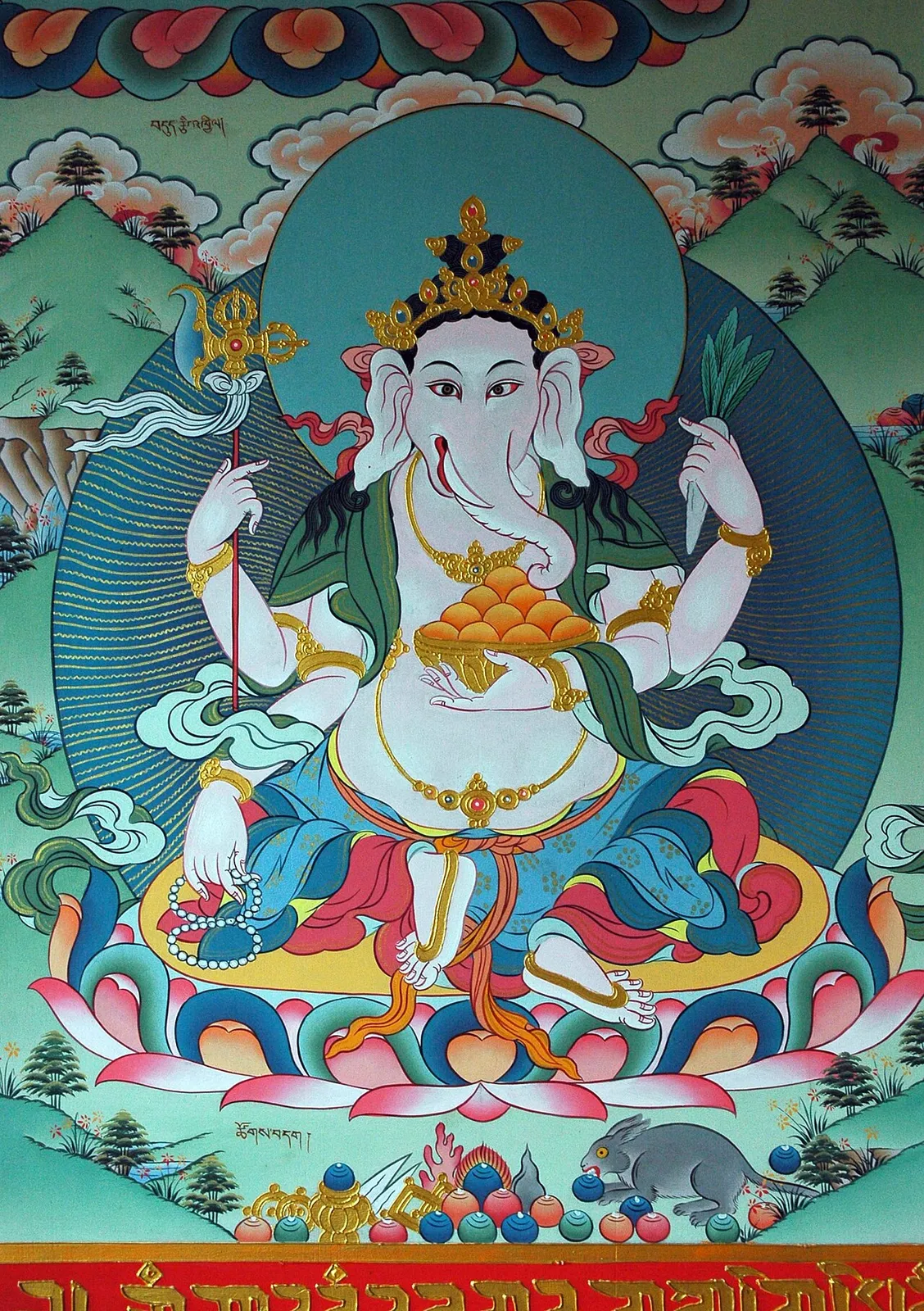
Ganapati, ‘Lord of Hosts’ (Tibetan Tsogdag), is the Buddhist counterpart of the elephant-headed Hindu god Ganesha. He has two contrasting roles in Tibetan Buddhism. As the creator of obstacles he is the elephant-headed figure trampled beneath the Six-armed Mahakala and other protectors. As a tantric deity in his own right he is invoked mainly for wealth and, in his red forms, for power over circumstances. Buddhist commentators treat this Ganapati as an emanation of enlightened beings and distinguish him from the god of the Shaiva religion.
The form most often painted is Maharakta, ‘Great Red’, Ganapati. He is red, with an elephant’s head, sharp white tusks, three eyes and twelve arms. The right hands hold an axe, arrow, hook, vajra, sword and spear; the left hold a pestle, bow, khatvanga staff, a skull cup of blood, a skull cup of flesh, and a shield with spear and banner. He dances with the left leg extended above a blue rat that disgorges jewels, beside a rock of lapis lazuli. Other forms are white or red with two, four or six arms, holding sweets, a radish, a rosary or a hook.
Atisha introduced a form called Ragavajra to Tibet in the eleventh century, and the Indian teacher Gayadhara brought further forms that descend through the Sakya school. There the red twelve-armed Ganapati, regarded as an emanation of Avalokiteshvara and linked to the Chakrasamvara tantras, is one of the Three Great Red Ones with Kurukulla and Takkiraja. The Nyingma treasure tradition added other forms. Most belong to the Kriya class of tantra. In Japan a related esoteric tradition produced the dual-bodied Kangiten.
Connections
8 linked records across the archive.
Sources
References consulted for this record.