FT·MAS·063Yogini & Female Master
Mandarava
མནྡཱ་ར་བ
Wylieman+dA ra baSanskritMandāravāDate8th century (traditional)
Indian princess of Zahor and consort of Padmasambhava, revered as a dakini of longevity who attained deathless realisation with him in the Maratika cave.
Also known asMandarava of Zahor · Lhacham Mandarava · Princess Mandarava · Mandarawa
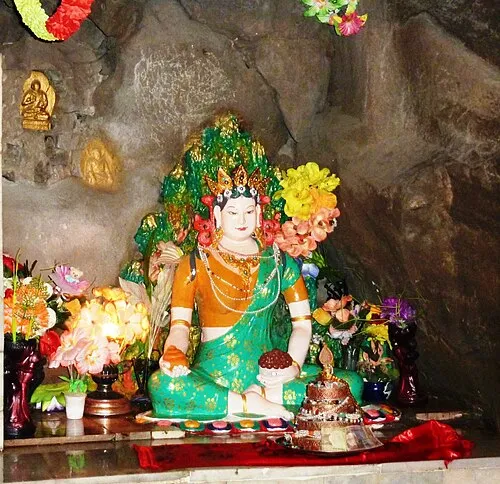
Mandarava is one of the two chief consorts of Padmasambhava, paired in devotion with the Tibetan Yeshe Tsogyal. She is described as a princess of Zahor, a kingdom that Himalayan tradition locates at Mandi in present-day Himachal Pradesh, who refused marriage in order to practise the Dharma. She belongs to sacred biography; no independent historical record of her survives, and her story is known from the lives of Padmasambhava and from later treasure texts.
The narrative tells that her father, angered to find a wandering yogin teaching his daughter, had Padmasambhava burned on a pyre and Mandarava cast into a pit. The fire turned into a lake with the guru seated unharmed on a lotus, and the king repented. The pair then travelled to the Maratika cave in Nepal, where they practised the rites of Amitayus, the buddha of boundless life, and gained mastery over lifespan. A full account of her life and previous births was revealed as a treasure by Samten Lingpa around 1900.
The lake of the legend is identified with Tso Pema at Rewalsar near Mandi, a pilgrimage site with several Tibetan monasteries and a monumental statue of Padmasambhava. Maratika, at Halesi in eastern Nepal, is visited for long-life practice. Mandarava is invoked in longevity rituals of the Nyingma school, and her image, white in colour and holding a long-life arrow and vase, appears beside Padmasambhava in temples and thangkas throughout the Himalayan region.
Connections
6 linked records across the archive.
Sources
References consulted for this record.
- 01Mandāravā — Wikipedia
- 02Mandarava — Rigpa Shedra Wiki
- 03Samten Lingpa, The Lives and Liberation of Princess Mandarava, trans. Lama Chonam and Sangye Khandro (Wisdom Publications, 1998)