FT·SYM·025Ritual Implement
Kartika
གྲི་གུག
Wyliegri gugSanskritKartṛkā
A crescent-bladed knife with a vajra handle, carried by dakinis and wrathful deities to signify the cutting of ignorance and self-clinging.
Also known asDrigug · Curved Knife · Flaying Knife · Chopper · Kartri
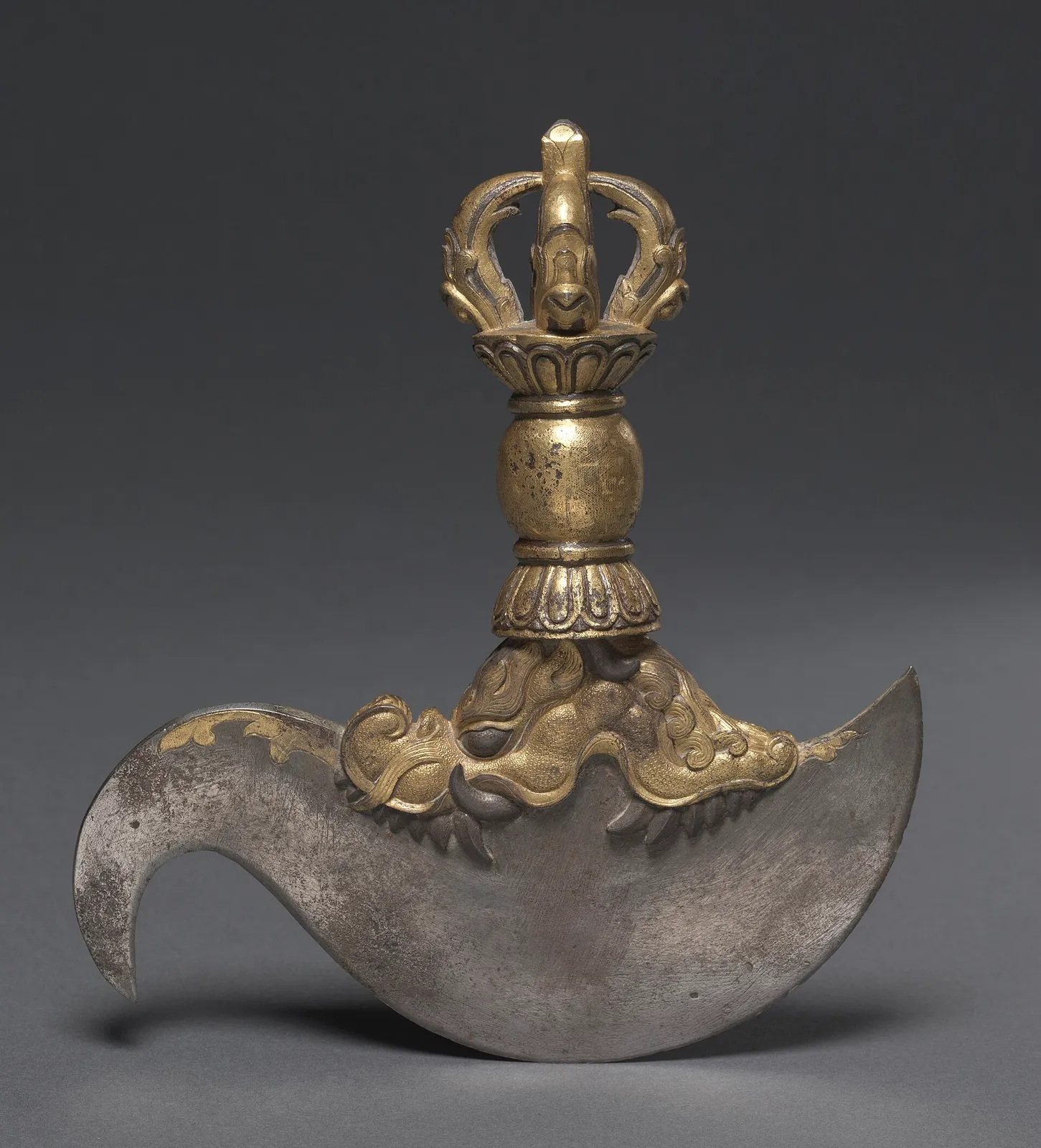
The kartika is a small hand chopper with a curved blade, modelled on the flaying knife used by Indian butchers and tanners. In tantric Buddhism it is chiefly the attribute of dakinis, the female embodiments of wisdom, and of wrathful protectors. It represents the severing of attachment to a self and the cutting away of the two obscurations, those of afflictive emotion and of limited knowledge. The knife is almost always paired with the skull cup. As a pair, the knife in the right hand is read as method and the cup in the left hand as wisdom.
The blade is a crescent with a sharp outer edge that ends in a small upturned hook, a shape designed for skinning. It is usually shown as blue-black iron. The blade is fixed to the handle by a leaf-shaped mount or issues from the mouth of a makara, a mythical water creature, and the handle is a half vajra, most often with five prongs. Ritual examples are cast in iron, bronze or brass, sometimes with gilding and inlay of gold and silver wire, and are small enough to be held in one hand.
Vajrayogini raises the knife in her right hand, and Mahakala in his six-armed and other forms holds it above a skull cup at his heart. In the practice of chö, the visualised offering of one’s own body taught by Machig Labdrön, the meditator imagines a dakini using the curved knife to open the body before it is transformed into nectar. Actual knives are placed on shrines for wrathful deities and are used to cut the dough effigy in rites of subjugation, where the effigy stands for the obstacle to be removed.
In the collection
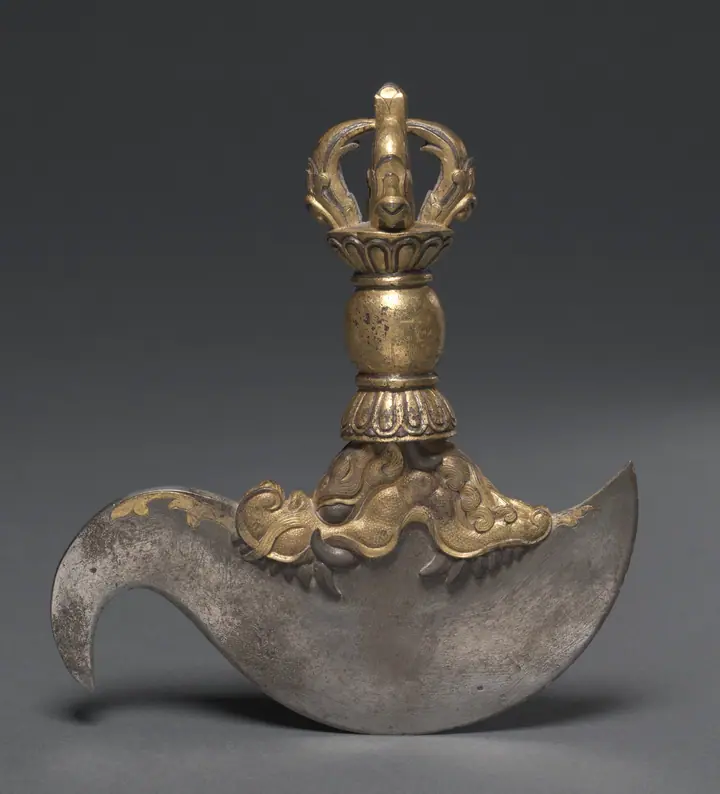
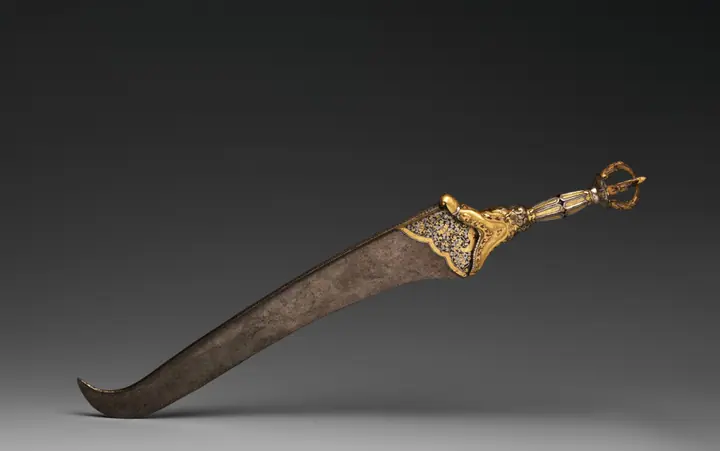
2 works in the collection relate to Kartika.
Connections
8 linked records across the archive.
Sources
References consulted for this record.
- 01Kartika (knife) — Wikipedia
- 02Ritual Object: Main Page — Himalayan Art Resources
- 03Robert Beer, The Handbook of Tibetan Buddhist Symbols (Shambhala, 2003)