FT·PLA·046Sacred Mountain
Kawa Karpo
ཁ་བ་དཀར་པོ
Wyliekha ba dkar po
Unclimbed 6,740-metre peak between the Mekong and Salween on the Tibet–Yunnan border, among the most revered sacred mountains of eastern Tibet.
Also known asKhawa Karpo · Kawagarbo · Kawagebo · Meili Snow Mountain · Nyenchen Khawa Karpo
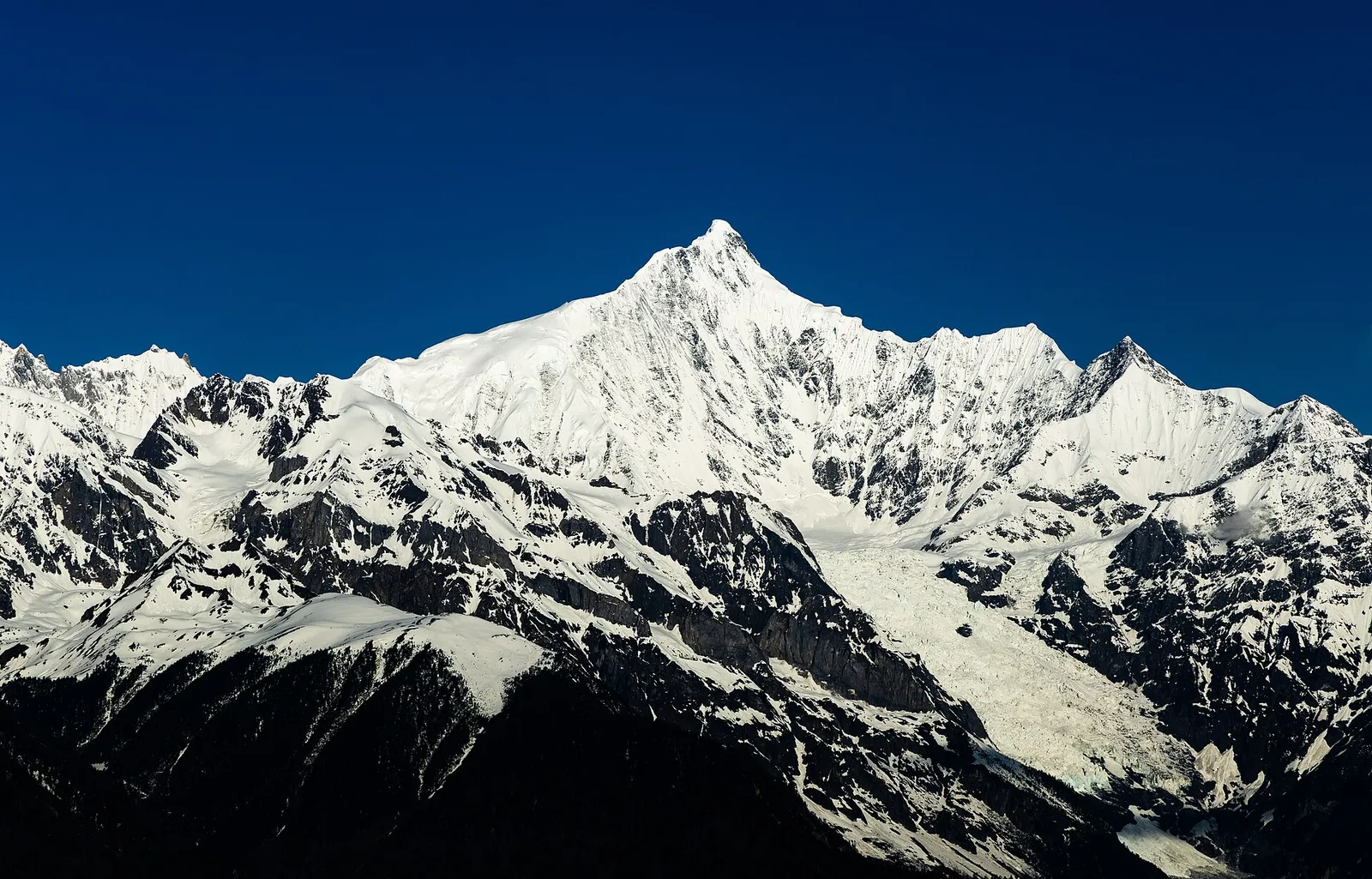
Kawa Karpo, ‘White Snow’, is the highest summit of the range that divides the Mekong from the Salween, on the border of Dechen county in Yunnan and the Tibet Autonomous Region. It is the principal sacred mountain of southern Kham and one of the great pilgrimage peaks of the Tibetan world. Tibetans know it both as a warrior mountain god, Nyenchen Khawa Karpo, mounted on a white horse, and as a palace of the tantric deity Chakrasamvara. Chinese maps call the whole massif Meili Xueshan, a name taken from a lower range to the north.
The mountain rises to 6,740 metres from the gorge of the Mekong, which lies less than 2,000 metres above sea level and barely ten kilometres from the summit, so that glaciers descend past forests of oak and rhododendron almost to the subtropical valley floor. The Mingyong glacier is the best known. Pilgrims make two circuits: an inner route to the temples and sacred waterfall near Yubeng, and an outer kora of about 240 kilometres that crosses several high passes into the Salween basin and takes ten days to two weeks. The Sheep year is its special year, most recently 2015.
Local people regard climbing as an offence to the mountain. In January 1991 an avalanche killed all seventeen members of a Chinese–Japanese expedition, one of the worst accidents in mountaineering; later attempts failed, and the local government banned climbing in 2001. The summit remains untrodden. The range lies within the Three Parallel Rivers of Yunnan Protected Areas, a UNESCO World Heritage Site since 2003. Researchers have documented the rapid retreat of the Mingyong glacier, and village communities, monasteries and conservation groups have worked together to protect sacred groves along the pilgrim routes.
Connections
7 linked records across the archive.
Sources
References consulted for this record.
- 01Kawagarbo — Wikipedia
- 02Three Parallel Rivers of Yunnan Protected Areas — UNESCO World Heritage Centre
- 03Katia Buffetrille, 'The Pilgrimage to Mount Kha ba dkar po: A Metaphor for bardo?', in Searching for the Dharma, Finding Salvation (Lumbini International Research Institute, 2014)