FT·ART·170Sculpture
Halo
1200s · Tibet
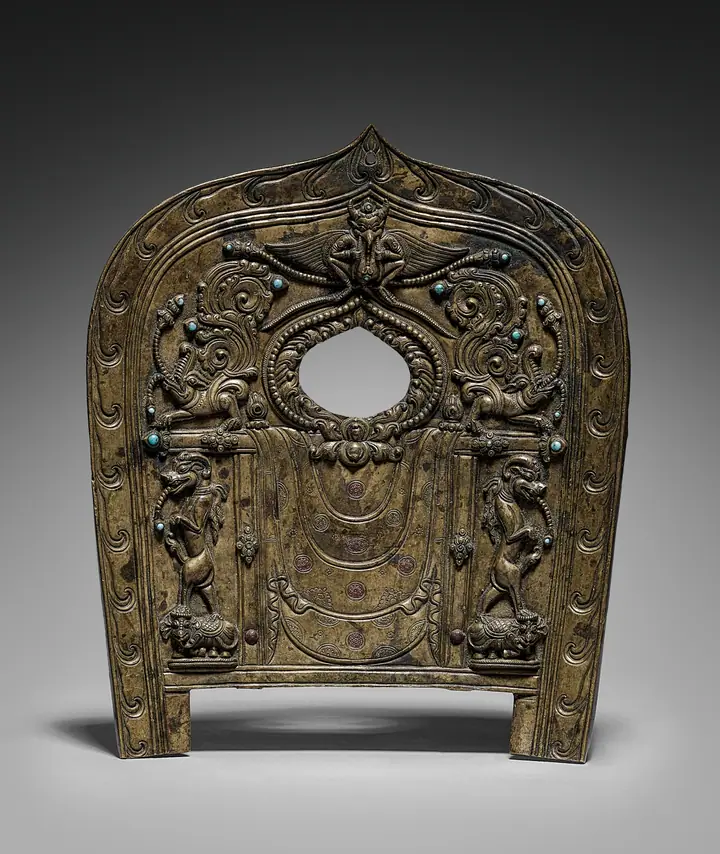
This is the smaller of two fragmented bronze sculptural elements that would have originally been oriented around a seated Buddha figure. In the center is a throne back with openings that allowed the now-missing figure to be visible from behind. The symmetrical imagery depicts at the apex a winged Garuda (man-eagle) grasping snakes he holds in his beak. Below, two crocodiles with foliate tails mark the transition from the seat to the halo. They are beings of the waters, referencing clouds that bring rain. Below, on either side, a composite horned leonine beast called a yali or vyala stands on the head of an elephant and holds a lotus stem with bud in his mouth and hands. These animals refer to shakti (energy) and waters of abundance. The openwork foliate cloud section surrounding the throne back is inhabited by Buddhist monks, practitioners, and the crowned Buddha Akshobhya.
Text: The Cleveland Museum of Art, open-access catalogue.
- Date
- 1200s
- Culture
- Tibet
- Medium
- bronze and red lacquer
- Dimensions
- with tang: 23.2 x 19.5 cm (9 1/8 x 7 11/16 in.)
- Classification
- Sculpture
- Accession no.
- 1995.404.1
- Credit line
- Gift of Emmanuel Moatti
- Holding museum
- The Cleveland Museum of Art
- Image rights
- Public domain (CC0)
Depicted and related
Related works
Works that share a subject, a form or a century.